

By
Brian Dakss
Senior Editor
Brian Dakss is a longtime New York-based editor and writer for CBS News, at the Radio network and with CBSNews.com. He has written and edited for NBC News, Dow Jones and numerous radio stations and been a radio anchor and reporter.
Read Full Bio

Kris Van Cleave
Kris Van Cleave
Emmy Award-winning journalist Kris Van Cleave is the senior transportation correspondent for CBS News based in Phoenix, Arizona, where he also serves as a national correspondent reporting for all CBS News broadcasts and platforms.
Read Full Bio
/ CBS News
Add CBS News on Google
Two pilots were killed and dozens of people were injured at New York’s LaGuardia Airport late Sunday night when an arriving Air Canada Express plane and a fire-and-rescue vehicle collided on a runway, officials said.
It happened after air traffic control apparently cleared the fire-rescue vehicle to cross the runway before telling it to stop, air traffic control recordings revealed.
The Port Authority of New York and New Jersey, which runs the airport, said in a statement that the pilot and co-pilot were killed in the collision. The two pilots were both Canadian, law enforcement sources familiar with the investigation told CBS News.
The plane was traveling at about 100 mph when the collision occurred, the sources said.
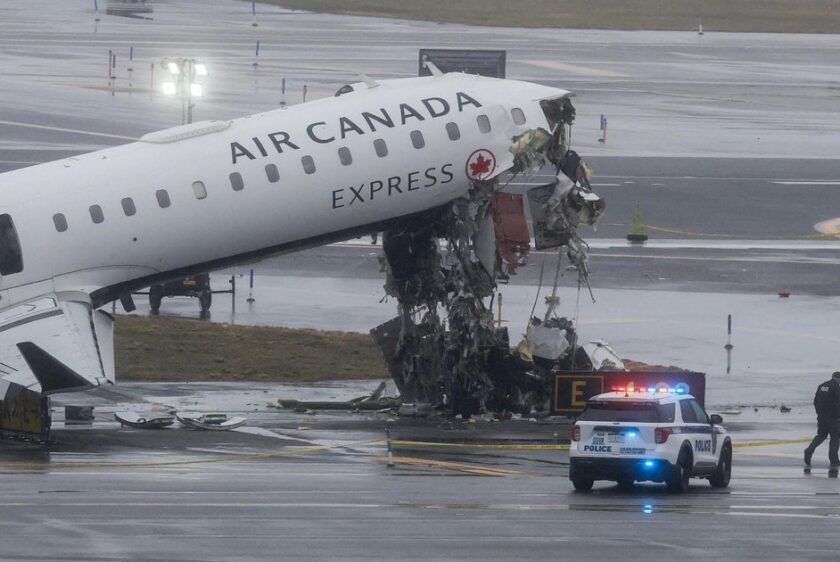
An Air Canada Express CRJ-900 sits on the runway after colliding with a Port Authority fire truck at LaGuardia Airport in New York, on March 23, 2026. TIMOTHY A. CLARY /AFP via Getty Images 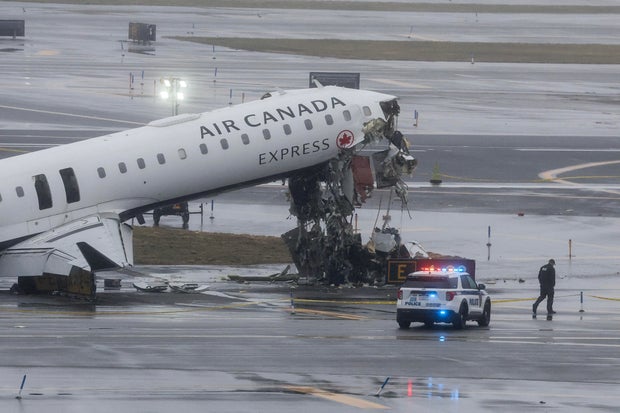
The Port Authority said Air Canada Flight 8646, operated by Jazz Aviation, had 72 passengers and four crew members on board, and that 41 people were taken to hospitals — 39 from the aircraft and two Port Authority Aircraft Rescue and Firefighting officers from the truck. Executive Director Kathryn Garcia said Monday morning that initial indications were that 32 people had been released from hospitals but there were also serious injuries.
According to the law enforcement sources, most of the injuries were broken bones and bruises, but one person suffered a brain bleed.
A flight attendant strapped to her seat fell through an opening in the severed aircraft, according to the sources. The flight attendant was found by rescuers still in the seat and was transported to a hospital with serious but non-life-threatening injuries.
A source told CBS News it appeared the collision was an accident and there was no foul play or terrorism suspected. Law enforcement sources told CBS News the so-called black boxes containing the flight data and cockpit voice recorders have been retrieved.
LaGuardia was closed after the accident and the Federal Aviation Administration issued a ground stop for the airport until 2 p.m. Monday. One runway at the airport has now reopened, but travelers are being told to expect delays and cancellations and to check with their airlines. The runway where the collision took place will be closed until Friday morning, according to an FAA notice.
Scene of passenger plane collision with fire and rescue vehicle at LaGuardia Airport in New York late on March 22, 2026. Selcuk Acar/Anadolu via Getty Images 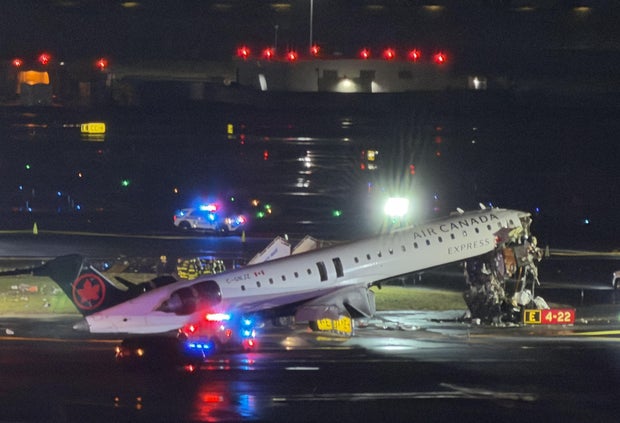
The collision happened as air traffic control was also responding to a separate incident where pilots of United Airlines Flight 2384 aborted their takeoff when an anti-ice warning light came on. They reported an odor in the cabin and requested assistance from firefighters. The pilots said flight attendants were feeling ill and declared an emergency when no gates were immediately available.
Air traffic control recordings indicate the fire-rescue vehicle was cleared to cross the runway before a controller then told it to stop.
Audio from ATC.com captures air traffic controllers speaking to the emergency responders on the ground.
Emergency vehicle: “Truck 1 and company LaGuardia Tower requesting to cross 4 at Delta.”
Air traffic controller: “Truck 1 and company, cross 4 at Delta.”
The vehicle operator confirmed, but then seconds later, the air traffic controller was back with an urgent message: “Frontier 4195, stop there, please. Stop, stop, stop, Truck 1, stop, stop, stop. Stop Truck 1, stop. Stop Truck 1, stop.”
Moments after, the controller can be heard acknowledging the collision.
An air traffic controller later talked about the collision with the pilot of a Frontier flight.
“That wasn’t good to watch,” the Frontier pilot said.
“Yeah, I know, I was here,” the air traffic controller responded. “I tried to reach out to my staff, and we were dealing with an emergency earlier and I messed up.”
“No man, you did the best you could,” the Frontier pilot responded.
Capt. Laura Einsetler, a pilot with more than 30 years of experience, called the deadly incident “very concerning.”
“It’s very unusual to have a situation where we’re landing on the runway and you have emergency equipment – emergency equipment operators on the runway itself,” she told “CBS Mornings.”
The Air Canada plane, which was coming in from Montreal, had landed and was slowing down when it collided with the Port Authority vehicle. The Air Canada plane, a CRJ 900, suffered significant damage. Images showed the mangled front of the plane lifted into the air and its tail on the tarmac.
Timothy Henriksen, a passenger on a Frontier Airlines flight that wound up being grounded, told CBS News, “We stopped and then the pilot came on and said there’s been an accident with an Air Canada and a fire truck. … We got a really good view of the plane missing the whole front nose.”
An Air Canada Express plane sits on the tarmac after it collided with a fire truck on the tarmac at LaGuardia Airport on March 23, 2026 in New York City. Spencer Platt/Getty Images 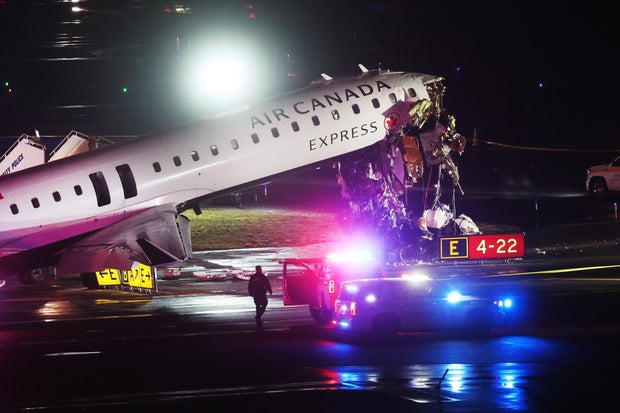
The National Transportation Safety Board said during a news conference Monday that a team of investigators recovered the cockpit voice recorder and flight data recorder, which will be transported to D.C. for analysis.
“I just want to express how much … there is a lot of debris. We need to go through all of that and to figure out what we need to take back to the NTSB, to our labs, what we might want to collect,” NTSB Chair Jennifer Homendy said, adding that evidence collection could take days.
Homendy also noted that the NTSB’s air traffic control specialist was in line for TSA in Houston on Monday for over three hours, and the agency had to intervene so they could catch their flight to New York.
Transportation Secretary Sean Duffy said at an afternoon briefing that the FAA also has people on site and that investigators will be working with a team from Transport Canada as well.
“It’s incredibly sad. It’s troubling. And I just want to let America know that we are working our hearts out to make sure that when people travel, whether by rail, or by car, or by air, that they travel safely. And we put in precautions and policies to make sure that you are safe when you travel,” Duffy said. He also said this incident serves as a reminder of the importance of wearing a seatbelt aboard planes.
A former chair of the NTSB, Robert Sumwalt, told “CBS Mornings” earlier Monday that the agency will look through air traffic control tapes, radar tapes and cockpit voice recorder tapes from the airplane during the investigation.
“They will have witness interviews, they’ll interview the controllers,” he said. “So they will have a lot to be able to go on.”
Sumwalt estimated the investigation will take between 12 and 18 months to complete.
Investigators will be looking into what the communication breakdown was that allowed the vehicle to be on the runway as the plane was landing. They will also want to understand if the air traffic controller was working alone in the tower.
Sarah Ploss and
Kathryn Krupnik
contributed to this report.
In:
- LaGuardia Airport
- New York


 English