
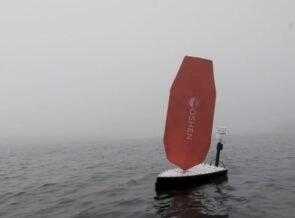
Five small uncrewed surface vehicles (USVs) have launched in the water off the US Virgin Islands to gather data to help further our understanding of hurricane development and activity.
The effort is a collaboration between the US National Oceanic and Atmospheric Administration and the University of Southern Mississippi. The five vessels are called “C-Stars,” and while five are in the water, another two are in storage in Gulfport, Mississippi, ready for deployment as needed.
Commenting on the new collaboration and project, Greg Foltz, oceanographer for NOAA’s Atlantic Oceanographic and Meteorological Laboratory (AOML), stated:
“Understanding weather conditions where the ocean surface meets the lower atmosphere is key to predicting hurricane intensity. If these miniature uncrewed surface vehicles prove reliable, they could become a critical piece of NOAA’s hurricane observing system in the future.”
While Leila Hamdam, Associate Vice President for Research at the University of Southern Mississippi and professor in the School of Ocean Science and Engineering, added:
“We are excited by the role that C-Stars could play in improving hurricane forecasts, which have direct consequences for millions of people along the Gulf Coast. The University of Southern Mississippi is a natural partner for this effort as we bring deep expertise in autonomous systems and a history of collaboration with Oshen and NOAA. We’re excited to test new ways to gather critical data for NOAA’s mission.”
Finally, Anahita Laverack, the Chief Executive Officer for Oshen, which built the USVs, added:
“Although C-Stars have navigated storms with towering 24-foot waves, hurricanes are a whole new level of challenge—but if it works, the long-term potential is huge. We believe that these new, small USVs can move the needle in how we observe and understand hurricanes, while keeping budgets under control.”
For more info about the C-Star USVs, go to oshendata.com.


 English