


Photo courtesy Kratos Defense
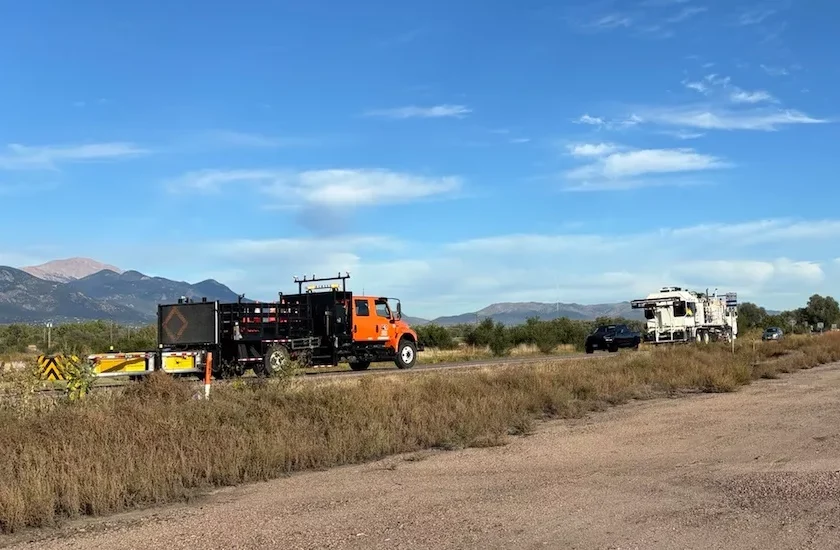
An autonomous crash truck follows a CDOT maintenance vehicle in southern Colorado in an effort to improve safety.
Highway maintenance is a dangerous job. In 2023 and 2024 combined, 47 people were killed on highways in Colorado work zones, including two roadside crew members.
The Colorado Department of Transportation (CDOT) has turned to autonomous crash trucks to help mitigate the problem. Such vehicles drive behind painting and maintenance vehicles to provide a safety buffer from highway traffic.
CDOT bought its first self-driving truck, underpinned by technology from Florida-based Kratos Defense, in 2016. It has since bought two more with plans to continue deploying such vehicles. Kratos’ autonomous truck-mounted attenuator (ATMA) allows the crash trucks to operate without a driver.
Heather Pickering-Hilgers, CDOT’s assistant director of mobility technology, said the program launched on low-traffic highways in southeastern and southern Colorado. “We try to keep on very low-traveled roads,” she says. “We’re still keeping it out of any major metro areas.”
A $1.7 million U.S. Department of Transportation Strengthening Mobility and Revolutionizing Transportation (SMART) Grant awarded to CDOT in 2022 funded the acquisition of the third vehicle. The award also funded an online toolkit to help other states launch their own ATMA programs.
“We are working with numerous other states,” says Pickering-Hilgers. “We’re hoping to apply for Stage 2 SMART Grant. We’re working with a bunch of other states to expand the program, not only in Colorado but across the country. We really feel like every state who wants one of these should be able to have one.” The next grant could be as high as $15 million, according to the USDOT website.
Military Tech Finds a Civilian Use Case
Maynard Factor, vice president of business development at Kratos, said the ATMA technology grew out of the company’s core market of providing autonomous vehicles to the military. He attended a Florida Department of Transportation event circa 2010 that alerted him to the concept of crash trucks. “I saw that this was a great way to adapt our driverless tech into the commercial space, and it aligned with the Kratos strategy of offering dual-use technologies,” says Factor.
Factor subsequently connected with Pennsylvania-based Royal Truck and Equipment, a primary supplier of crash trucks. “Within a week, I had a truck and we automated it,” he says. “It was the first one that had ever been done.”
ATMA uses GPS and inertial navigation for self-driving, as Kratos evaluates optical navigation systems. The systems also have fully redundant backup communications technology with “military-grade encryption,” says Factor.
A soft launch in Pennsylvania followed in 2014, then a United Kingdom-based company was the first contract for an ATMA for a paying customer, also in 2014. “The very next contract I got was with the Colorado Department of Transportation,” he says.
CDOT’s staffers “were already aligned with a tech innovation program, and this ATMA project fit very well into that program,” says Factor. “They had a dedicated team to evaluate the technology, validate it in the use case, and make recommendations for continuous improvement of the tech and capabilities. Basically they were the subject matter experts in how they do highway maintenance, and they had a team that was very strong in vehicle automation technologies.”
Factor says Kratos has since deployed 15 systems to other states, including Missouri, North Dakota, Minnesota, Ohio, Oklahoma and California. Colorado has the most with three, and Missouri is second with two systems.
Some states have a safety rider in the truck. “The main reason for that is the legislation hasn’t quite caught up with the tech yet in those locations to permit a driverless, 36,000-lb truck on the roadway,” explains Factor.
There’s plenty of room to grow in Colorado and beyond, he adds. Colorado has nearly 200 legacy crash trucks across 10 regions, and there are near-term plans to deploy one autonomous vehicle in each district. “A longer-term goal is to have a solid percentage of those vehicles automated so the workers can use them and deploy them in their normal day-to-day activity,” says Factor.
Pickering-Hilgers says that Kratos has been a terrific partner for CDOT. “We’re just trying to make it better each time,” she notes. “It’s been really nice to work with our vendor [Kratos], and tell them what works and what doesn’t. Each one has gotten a little bit better in terms of their sensors and cameras and things like that, so we continue to refine it, and they listen to us, which is great.”


 English