

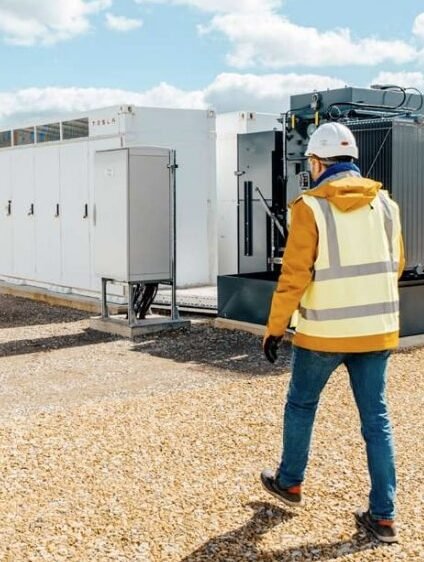
A South Australian council has raised concerns about a big battery project taking up prime agricultural land, but the developer says it is the most affordable way to bring renewable energy to the area.
Portugal-based TagEnergy wants to build a 600-megawatt-hour battery energy storage system (BESS) on 11 hectares of land just west of Naracoorte, near an existing substation and a large power line.
The Kincraig BESS would be among the largest battery projects in Australia if approved, and the same as another TagEnergy is building at its Golden Plains wind farm in western Victoria.
TagEnergy Australia managing partner Andrew Riggs said the lack of renewable energy projects in South Australia’s south-east made it attractive for investors.
The current (top) and proposed view from Lucindale Road when the Kincraig Battery Energy Storage System is built. (Supplied: TagEnergy)
He said the batteries would take in rooftop solar power and electricity produced from wind turbines when it was cheap, and then sell it later to consumers when there was less supply available.
“With all the batteries being built around the country, one of the key economic drivers is to not have to build a whole lot of new infrastructure,” Mr Riggs said.
“So when you have an existing substation like that, it provides a low-cost way to join the grid and, of course, that keeps down the cost of energy for everyone.”
Range of worries
The Naracoorte Lucindale Council, through the Northern Limestone Coast Regional Assessment Panel, has already approved three much smaller battery projects near the same Kincraig substation — two by ACEnergy and another by Flow Power.
Trees that TagEnergy says will screen its Kincraig Battery Energy Storage System (BESS) project from other properties. (Supplied: TagEnergy)
But, due to the size of TagEnergy’s project, development approval will be considered by the State Commission Assessment Panel rather than the council.
The South Australian Department of Energy and Mining is also consulting on the project.
Patrick Ross argues agricultural land is being overrun by development proposals. (Supplied: Naracoorte Lucindale Council)
While not outright opposing it, the council will write to the department with worries about the project taking up agricultural land, potentially causing groundwater contamination and raising the local fire risk, as well as the impact on local roads and the views of the development from Lucindale Road.
Mayor Patrick Ross said the big battery would take up valuable farming land but only provide five ongoing jobs.
“We continue to see some of the best agricultural land in the state, not only here in the South East but other areas, especially to the north of Adelaide, being overrun by development proposals which are out of [councils’] hands,”
he said.
“These are all run by the state government through the planning [department], and this pretty much can’t go on unchecked without the appropriate due diligence occurring, especially from our part.”
Mixed renewables success
Two large battery projects with a combined capacity of 1,500 megawatt hours are being built just north of Mount Gambier.
The state government has refused approval for offshore wind turbines near Kingston South East, while the federal government backed down on an offshore wind zone being proposed off Port MacDonnell.
A group has formed opposed to the mining of rare earths, which are used in wind turbines, south of Naracoorte at Wrattonbully.


 English