
This week I took a trip from Wodonga to Adelaide, then up to Hornsdale, combining for more than a 2,000km round trip to visit the OG, Tesla’s Big Battery.
It is hard to believe it has been nearly a decade since I covered this project, but here we are and I finally had the chance to go see it with my own eyes.
What started as an ambitious bet has transformed into one of the most reliable and critical assets in Australia’s National Electricity Market. Since it was established (and I covered it on techAU), going to visit the site was always on my to-do list, and now I’m really glad to have finally achieved that.
As if the 10-11 hour trip from Wodonga to Adelaide wasn’t enough, the final leg of the journey was to to Hornsdale Power Reserve, another 226 kilometres north of Adelaide. This was definitely a multi-day exercise, made possible with Tesla’s Autopilot and Supercharging network.
If you ever embark on this trip yourself, be prepared a whole lot of nothing, occasionally broken up by small towns with tiny populations. Thankfully the charging network in Australia has evolved to mean a road trip like this is possible and actually quite easy to achieve now.
Once you reach the final turn off, you’ll venture onto an unsealed gravel road that is thankfully in very good condition. This road itself is some 4km+ long before you reach the Hornsdale Power Reserve.
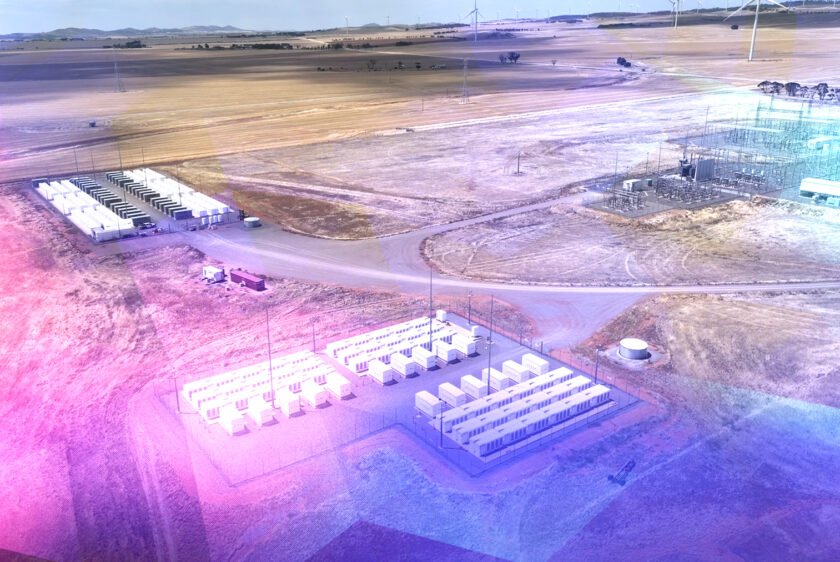
The giant wind turbines are hard to comprehend the scale of until you see them for yourself, but then there’s the facility itself. Public access to the site is restricted, as you expect from an active energy provider, however you do see a massive on-site substation responsible for taking the energy from the wind farm, and storing it in the battery, then sending that power to the energy grid.
Whil located at the back of the site, you can see rows upon rows of Tesla megapack units sitting silently in the landscape, doing work that traditional power plants simply cannot match.
The bet that changed the Australian energy landscape
The origin story of the project is now legendary in tech circles, born from a 2017 Twitter (now X) exchange between Elon Musk and Atlassian co-founder Mike Cannon-Brookes.
At the time, South Australia was reeling from a statewide blackout and searching for urgent solutions to grid stability. Musk made the bold claim that Tesla could solve the problem by installing 100MW of storage in 100 days, or the system would be free.
Tesla will get the system installed and working 100 days from contract signature or it is free. That serious enough for you?
— Elon Musk (@elonmusk) March 10, 2017
Mike Cannon-Brookes didn’t hesitate to take the bet, and the race was on to build what was then the world’s largest lithium-ion battery.
Tesla didn’t just meet the deadline; they smashed it, completing the initial 100MW/129MWh installation in roughly 60 days.
Software meets hardware with Tesla Autobidder
While the physical footprint is impressive, the real magic of Hornsdale happens within the code, specifically through Tesla Autobidder. Autobidder is a real-time AI trading platform that acts like an “Autopilot” for the energy market, making split-second decisions 24/7.
It uses machine learning to forecast electricity prices, load, and generation to ensure the battery is always providing the best value. It essentially buys power when it is cheap (often when solar and wind are peaking) and sells it back when the grid is under pressure.
This automated system is much faster and more precise than any human operator could ever hope to be. It is the reason the battery can respond to grid drops in 0.14 seconds, often stopping a price spike before consumers even notice a flicker.
Virtual machines and the death of gas peakers
Such was the success of the project that in 2020, Neoen and Tesla completed a massive 50% expansion of the site, bringing the total capacity to 150MW/194MWh.
This expansion introduced a revolutionary feature called “Virtual Machine Mode” which is a complete game changer for grid stability. This technology allows the battery’s advanced inverters to provide essential inertia support to the grid, emulating traditional fossil fuel generators.
Historically, inertia was only possible with massive rotating turbines found in gas or coal plants to keep the grid frequency stable. Now, Hornsdale provides about 15% of South Australia’s inertia needs, proving that batteries can handle the “heavy lifting” of grid management.
This has significantly reduced the need to keep expensive, polluting gas-fired plants running just to provide system strength.
Collaboration with AEMO and market impacts
The success of Hornsdale is a result of deep collaboration between Neoen, Tesla, and the Australian Energy Market Operator (AEMO). AEMO uses the battery to provide Frequency Control Ancillary Services (FCAS), which keeps the grid at a steady 50Hz.
Before Hornsdale, this market was dominated by a few gas generators that could charge high prices during volatile periods. When the battery entered the market, the cost of these services in South Australia dropped by an incredible 90%.
Independent analysis indicates the battery delivered more than A$150 million in savings to the market in its first few years of operation.
“The strong collaboration with Neoen and supporting partners to develop an inertia-enabled grid-scale battery demonstrates what can be achieved to support Australia’s once-in-a-century energy transformation.”
Daniel Westerman, CEO, AEMO.
A blueprint for Australia’s renewable transition
The impact of Hornsdale stretches far beyond the South Australian border, acting as a proof-of-concept for the entire nation.
Because of this success, we are seeing a massive boom in battery investments across Victoria, New South Wales, and Queensland. Projects like the Victorian Big Battery and the Waratah Super Battery are direct descendants of the lessons learned at Hornsdale.
The transition to renewables is accelerating, with the share of renewable energy in the National Electricity Market reaching record highs. AEMO’s Integrated System Plan now views large-scale storage as the backbone of the future grid as coal plants continue to retire early.
Australia is currently on track to reach 82% renewable energy by 2030, a goal that seemed impossible before the “Big Battery” arrived.
The future of Australian energy storage
As I drove back to Wodonga, I couldn’t help but feel optimistic about the direction of Australia’s energy future.
We are moving from a system of slow, centralized coal plants to a fast, distributed network of wind, solar, and massive batteries. The Hornsdale Power Reserve was the first to prove that this model isn’t just a green dream, but a commercially superior reality.
It has paved the way for trillions of dollars in global investment and secured Australia’s place as a world leader in energy tech. For a tech enthusiast, seeing this in person is like visiting a temple of the future where hardware and software perfectly converge.
If you have the chance to make the trip, it is a powerful reminder of how a single bold idea can change the world.
For more information, head to https://hornsdalepowerreserve.com.au/


 English