

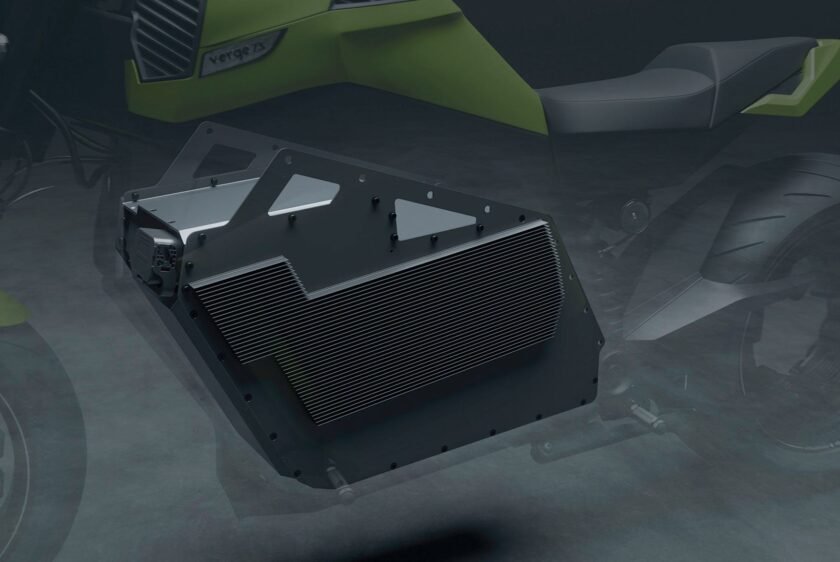
On the opening day of CES 2026, we covered the splashy debut of the Verge TS Pro electric motorcycle, powered by what’s claimed to be the world’s first application of a true solid-state battery in a road-legal production electric vehicle. The high points of this solid-state, Donut Lab battery pack: 400 watt-hours-per-kilogram cell-level energy density, up to 370 miles of range from 33.3 kWh, and 200kW charging back to 80 percent in 10 minutes. The fun part is discharging it via the hub-less Donut motor, which twirls out 737 lb-ft of torque that will slingshot the 518-pound bike to 60 mph in 3.5 seconds. Cake icing: it’s claimed to be cheaper to produce and is being sold at the same price as the conventional lithium-ion battery pack that powered earlier Verge bikes. Let’s take a little deeper dive into the tech.
Real Solid-State?
No third party has had a chance to saw one in half, and Donut Lab has yet to divulge the specifics of its chemistry, except to say its electrolyte is dry and that it “is made entirely from abundant, affordable, and geopolitically safe materials, does not rely on rare or sensitive elements, and demonstrates a lower cost than lithium-ion.” We’ll be eager to learn about the engineering breakthroughs or disclaiming asterisks that square this materials assertion with that energy density and cost scenario, because of these apparent contradictions:
- Abundant/conflict-free materials suggest lithium-iron-phosphate cathode and graphite or hard-carbon anode, but no LFP/graphite battery has approached 400 Wh/kg.
- Lithium-metal anodes are great for energy density, but would struggle against the abundant/affordable assertions.
- Silicon-rich anodes cut the price, but lithiation during charge/discharge process involves a lot of expansion and contraction, and the photo of the 5kWh module didn’t appear to leave much room for 40 cells plus springs or other measures to cope with expansion. (Note: at this module level, claimed energy density drops to 350 Wh/kg.)
- “True” dry solid-state generally portends a more exotic ceramic electrolyte. A quasi-solid polymer matrix better fits the affordability scenario, possibly with ceramic fillers to boost conductivity.
- With 1GWh/year production capacity announced, we further expect a polymer- or polymer-composite-based electrolyte, as this can be produced on existing roll-to-roll equipment without the need for an extremely dry environment (like sulfide-based electrolytes need) or high-temperature and/or pressure required for sintering ceramics.
Battery Form Factor
The cells are produced in 125Wh prismatic type pouches with the power tabs along the short side. The Donut Lab display included a 5kWh module, but the Verge motorcycle folks in the adjacent booth noted that’s not necessarily the way the 20.2- and 33.3-kWh worth of energy gets stored aboard the bike.
Donut Motor
One of the secrets to the Donut motor’s torque density is its inverted design that places the stator inboard and the rotor outboard. This gives the active rare-earth magnets way more torque-arm leverage, and it allows a motorcycle swing arm to connect directly to the stator. Car suspension designs have been designed to connect to the center of the wheel, so a plate bolted to the outer rotor mounts a conventional wheel in automotive applications.
Modular Motors
Donut Lab’s display showed motors ranging and size, power, and torque that included:
- 12-inch, 4-30 kW (5-40 hp) and 59-258 lb-ft
- 17-inch, 55-150 kW (74-201 hp) and 553-885 lb-ft
Each was displayed in both open hub and enclosed forms. We were told the 3.5-second Verge TS Pro bike’s open hub 17-inch motor makes 137 hp. Oh, and just as a reminder about that whopper torque spec: A combustion-powered bike of similar performance would enjoy somewhere around 13:1 torque multiplication between its crank and the wheel, so this equates to around 57 lb-ft of crank torque.
How Much for a TS Pro Bike?
You can order one now, in standard-range trims with a 20.2 kWh pack, 100kW charging, and a 217-mile range for $30,000 (this is the same price and range Verge was getting with a traditional lithium-ion pack of equivalent size). The long-range model gets a 33.3-kWh pack, 200kW charging, and a 370-mile range for $34,900 (pricing does not include destination charge, as it varies by location). Note that both models feature NACS charging, and each can add 186 miles of range in 10 minutes. Note that a $44,900 TS Ultra model is expected to follow soon, pairing the big battery with Donut Lab’s top-spec, 201-hp/885-lb-ft 17-inch motor, which supposedly slices a second off the 0-to-60 time. It will also boast a comfier single seat and some advanced driver assist/warning systems (boasting six cameras plus front- and rear-facing radar).
We’ll share more details on the solid-stateliness of Donut Lab’s newsmaking battery pack as we get them.


 English