

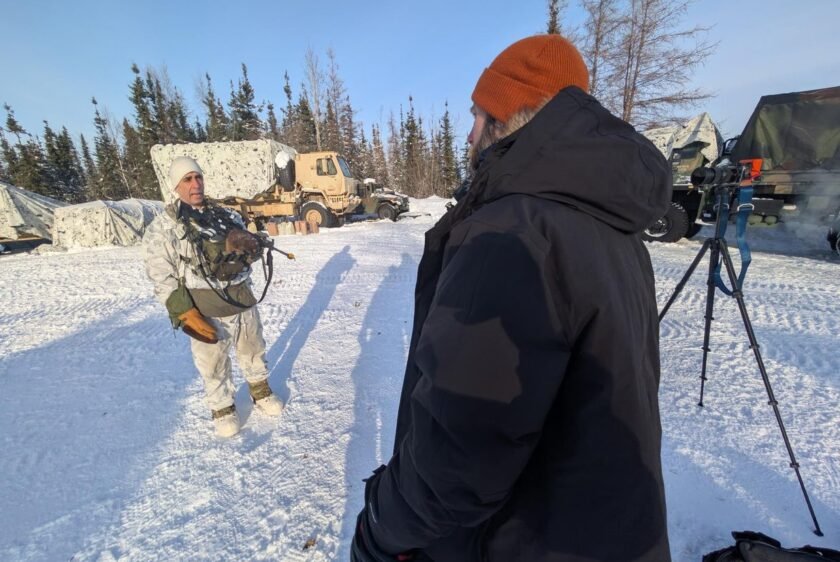
Arctic Notebook, Feb. 21: Washington Times Defense and National Security Correspondent John T. Seward is on assignment in frigid northern Alaska, covering the U.S. Army’s “premier Arctic training exercise.” As tensions rise in the frozen north, Mr. Seward’s reporter’s notebook dispatches go inside his experience observing the American military’s preparation for combat in the sub-zero temperatures.
FORT WAINWRIGHT — Today was my first day with troops in the direct fight, training against another U.S. Army unit.
I got the chance to spend the first half of the day in a CAT-V, the Cold Weather All-Terrain Vehicle. It is a winter warfare vehicle unique to the Arctic units and much more capable than the cars we were driving there to see it.
It was -40° on the road leading up to the brigade commander. Surprisingly, the sky is exceptionally clear and pale blue. It seems as though the colder it gets, the more often it’s a clear day.
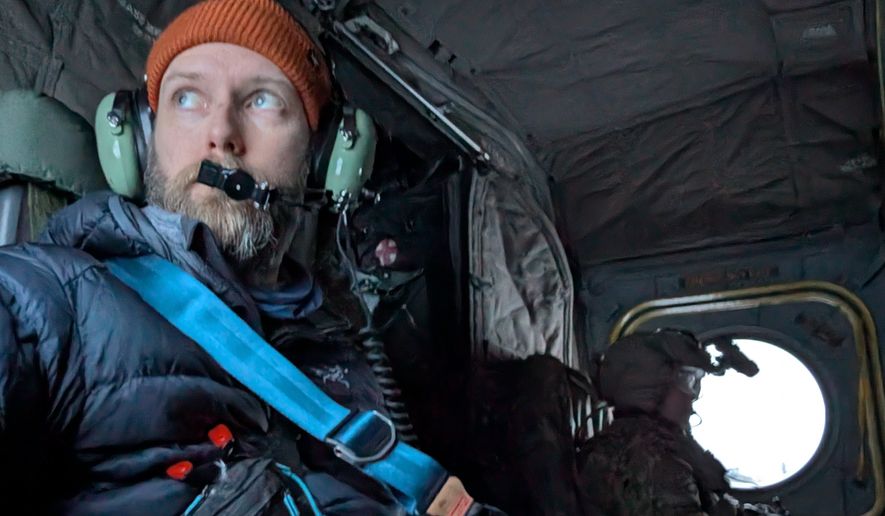
John T. Seward prepares for lift off with the 1-52 General Support Aviation Battalion in a Chinhook helicopter to observe an Air Assault mission. The mission infiltrated four snow mobiles and heavy sleds with supplies and equipment across the battlefield.
John T. Seward prepares for lift …
more >
Shortly after arriving I was asked by the commander if I wanted to ride in the trailer of his CAT-V with him and his team while we talked through the operation. We’d do the interview when we got where we were going.
It was a bumpy ride, even by military standards. The team is smart, sharing snacks during smoother patches to make sure to keep taking in calories. The commander puts together a sandwich and I get offered some cookies. On our way to the next spot, the commander stops to conduct a promotion for a young soldier.
Someone on the observer team — military leadership from another unit that acts as the graders for this simulated battle — said the promotion was against the rules of the fight. They “kill” the brigade chaplain and another soldier as a consequence.
After, the commander and his crew grumble and laugh off being discouraged in their support for a soldier during the exercise. The young specialist was obviously inspired by having the commander there to promote her and said as much in short remarks to the small group after.
Eventually we stop, get out, and do an interview in the middle of a circle of idling vehicles. They cut the wind and provide a nice backdrop, but the noise can’t be helped. By then it was time for me to leave. My host and I had to be back to the base airfield and jump on a helicopter for tonight’s air assault missions.
It’s not cold on the helicopter. They keep it at a nice 58° in the front of the Chinhook’s cargo area. Honestly, too warm for me as I’ve started to adjust to the — relatively mild — Arctic cold.
We take off, land and pick up two large snowmobiles that are pulling cargo sleds. The sleds are so heavy that the soldiers struggle to get them up the ramp.
It takes us nearly 30 minutes to load, an operation that would normally take 10. Everything takes longer in the Arctic.
The cargo area had the slight smell of JP-8, the special formulation of diesel fuel used by the military. It reminds me of how much all this equipment drinks.
We drop off our first group and turn around for a second. The crew chief and I talk and he’s comfortable with me filming the second group as they ride their snowmobiles off the ramp.
As we touch down and they unload, I get ready to follow them out. As I ran off the ramp after the second machine, I immediately got hit with the gust of rotor wash, the wind off the helicopter’s propellers. It’s been years since I’ve felt that, and it feels amazing, but very cold.
By the time we finish dropping off the second group, the crew radios back that they can only see three miles in front of them and the weather is closing in.
We head back to the hangar without being able to deliver the last group of soldiers.
As I close out for the night, it’s -10 degrees.
This is the third installment of a four-part Threat Status series, “Arctic Notebook.” Click here for the first installment and here for the second.
Click here to receive the daily Threat Status newsletter delivered directly to your inbox.


 English