


A next-generation calcium battery breakthrough could challenge lithium and transform clean energy storage.
A research team at The Hong Kong University of Science and Technology (HKUST) has reported a major advance in calcium-ion battery (CIB) development that could influence how energy is stored in everyday technologies. By integrating quasi-solid-state electrolytes (QSSEs), the scientists created a new type of CIB designed to improve both performance and environmental sustainability.
The innovation could support renewable energy storage, electric vehicles, and other power-hungry applications. The results were published in Advanced Science in a paper titled “High-Performance Quasi-Solid-State Calcium-Ion Batteries from Redox-Active Covalent Organic Framework Electrolytes.”
Growing Demand for Lithium Alternatives
As global investment in renewable energy accelerates, the need for dependable, high-capacity batteries continues to rise. Lithium-ion batteries (LIBs) currently dominate the market, but concerns about limited lithium supplies and constraints in energy density have pushed researchers to search for alternatives. Exploring battery chemistries beyond lithium has become increasingly important for long-term energy security and sustainability.
Calcium-ion batteries offer several advantages. Calcium is widely available, and CIBs operate within an electrochemical window comparable to that of LIBs. Despite this promise, practical challenges have slowed their progress. Efficient movement of calcium ions inside the battery has been difficult to achieve, and maintaining stable performance over repeated charging cycles has proven problematic. These limitations have prevented CIBs from competing directly with commercial lithium-ion systems.
Redox Covalent Organic Framework Electrolytes
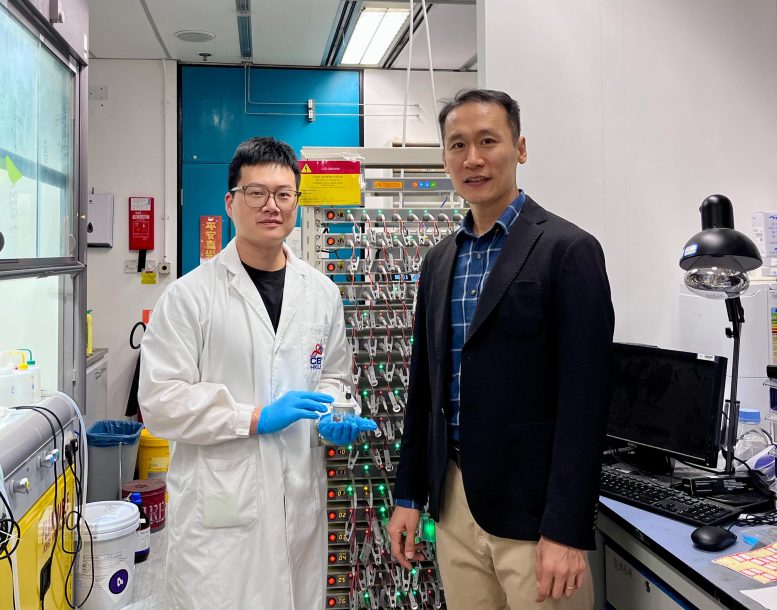
To address these technical barriers, the team led by Prof. Yoonseob KIM, Associate Professor in the Department of Chemical and Biological Engineering at HKUST, developed redox covalent organic frameworks that function as QSSEs. These carbonyl-rich QSSEs achieved strong ionic conductivity (0.46 mS cm–1) and Ca2+ transport capability (>0.53) at room temperature.
Through a combination of laboratory experiments and computational simulations, the researchers determined that Ca2+ ions move quickly along aligned carbonyl groups within the ordered pores of the covalent organic frameworks. This structured pathway enables faster ion transport and contributes to improved battery stability.
High Performance Over 1,000 Cycles
Using this approach, the team built a full calcium-ion battery cell that delivered a reversible specific capacity of 155.9 mAh g–1 at 0.15 A g–1. Even at 1 A g–1, the cell retained more than 74.6% of its capacity after 1,000 charge and discharge cycles. These results demonstrate the potential of redox covalent organic frameworks to significantly strengthen CIB technology and move it closer to practical use.
Prof. Kim said, “Our research highlights the transformative potential of calcium-ion batteries as a sustainable alternative to lithium-ion technology. By leveraging the unique properties of redox covalent organic frameworks, we have taken a significant step towards realizing high-performance energy storage solutions that can meet the demands of a greener future.”
Reference: “High-Performance Quasi-Solid-State Calcium-Ion Batteries from Redox-Active Covalent Organic Framework Electrolytes” by Zhuoyu Yin, Jixin Wu, Ye Tian, Yufei Yuan, Muhua Gu, Lei Cheng, Yanming Wang and Yoonseob Kim, 16 November 2025, Advanced Science.
DOI: 10.1002/advs.202512328
The project was conducted in collaboration with researchers at Shanghai Jiao Tong University.
Never miss a breakthrough: Join the SciTechDaily newsletter.
Follow us on Google and Google News.


 English