


Alvin discovered his love for writing while wrapping up his first degree in Analytical Chemistry. As a technology enthusiast, he started his writing career as a tech writer dabbling in different aspects of technology in 2019.
Now, with an IT degree under his belt and over five years of writing experience, he specializes in writing instructional programming tutorials on HTML/CSS, JavaScript, Python, Cloud, and Linux. Outside of writing, he works as a software engineer.
Alvin joined MUO in May 2021. His work has been featured in several publications, including XDA Developers. Outside of software engineering and writing, he’s passionate about travel and fitness.
I’d been using Chrome as my go-to browser since I got my hands on my first Android smartphone. That’s the case for most people, as it comes pre-installed. But while Chrome was my primary browser for years, there are alternatives that you can use. In fact, there are many Chrome alternatives that you can switch to if you want a break from Google’s browser right now.
Aside from its well-documented privacy and high memory usage issues, I didn’t expect Chrome to be such a contributor to my high battery usage on Android. But after finding proof that it played a part in my phone’s battery drain, I started looking into alternatives. I’ve finally found Brave as the perfect browser for my Android phone.
My battery drain problems with the Pixel 6a
My aging phone couldn’t keep up
Before letting go of my Google Pixel 6a in November 2025, I had been using it for slightly over three years, since September 2022. As you can imagine, by the time I decided to look for an alternative, the battery health wasn’t good—I had to charge the device several times a day, otherwise it would shut down. This is typical for any battery-powered consumer gadget. If you’ve used an aging Android phone in the past, you know that once the battery health drops, every percentage point matters. Because of poor battery health, battery drain was such a big issue on my old Google Pixel 6a that I started finding ways to stretch my battery life as much as possible.
That meant ditching apps that were reported to have high battery usage, like Facebook, and accessing any necessary services that had web apps via Chrome, my go-to browser at the time. As I began to use the browser more, I started to notice surprisingly high battery use by Chrome that didn’t quite make sense. After all, I wasn’t using the browser for more than an hour or two a day on average. But when it came to my phone’s battery usage statistics, Chrome ranked higher than other apps, which had more screen time. At that point, I knew Chrome was using more battery than it needed—I just didn’t have concrete data to back up my suspicion.
You can check your phone’s battery usage by navigating to Settings > Battery > Battery usage. On the Battery usage screen, you can see the battery level since last full charge, screen time since last full charge, and a breakdown of each app’s usage, with separate screen time and background activity stats.
The steps for checking battery usage may vary based on your phone’s manufacturer and the version of Android installed.
You’re not wrong, Chrome uses a lot of battery
Chrome is resource-hungry

I write about tech, so I was quick to check online if the issue was unique to me. I used search queries such as “Chrome Android battery drain” and “High battery usage on Chrome Android.” Dozens of results showed up, and it became clear that, yes, I wasn’t the only one experiencing high battery drain while using Chrome. On Reddit alone, I stumbled across several threads of other Android users complaining about Chrome’s battery use. It wasn’t specific to my smartphone brand either. I saw some users with OnePlus phones complaining, some with Samsung Galaxy devices, and so on.
If it were specific to Google Pixels, I would’ve definitely known it wasn’t the browser, but my phone manufacturer. But since that wasn’t the case, that was more than a confirmation that Chrome used a lot of battery on Android, and no one is safe. Then, in July 2025, I stumbled across an analysis from Brave Browser that pitted major Android browsers against each other on several resource usage metrics. The research benchmarked five major Android browsers, including Brave, Chrome, DuckDuckGo, Edge, and Firefox.

I ditched Chrome for this lightweight browser — and my PC’s faster than ever
This browser offers Chrome familiarity with less memory use and hidden tracking.
It compared the five on CPU utilization, bandwidth consumption, memory usage, page loading time, and, most importantly, battery usage. From the results of the benchmark, Chrome was the third-most battery-draining browser, behind Edge and DuckDuckGo. For DuckDuckGo, Brave noted it was due to a bug and submitted an issue to DuckDuckGo’s team to rectify the bug. But for Chrome, there was no excuse. That made it clear to me that it was time I switched to a different browser.
Since my phone’s battery health wasn’t good, it was important at that point to try and get more screen time. If switching browsers alone could give me even 30 minutes of battery life each day, it would be a massive win for my aging Pixel 6a.
How I picked my new battery-efficient browser, Brave
Brave was an easy pick

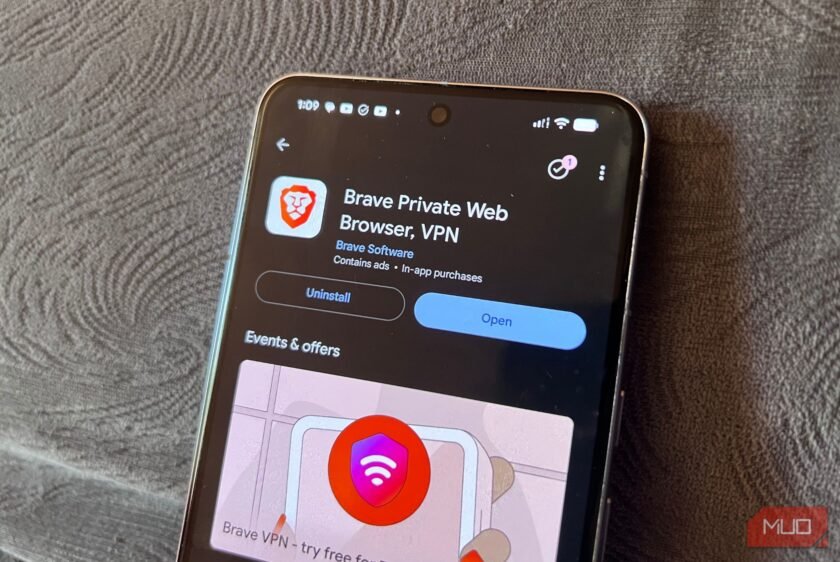
According to the research, Brave uses 3.9% less battery on average than the other four browsers. That made it clear as day that Brave was my new favorite browser. And sure enough, my battery usage from browsing did decrease after switching to Brave. After using it for a while, I’m convinced Brave is the best browser.
You need a better browser for your Android phone
Chrome is convenient, but if you use the browser frequently on a day-to-day basis, you should try something else if you need to stretch your battery. As shown in Brave’s research, Chrome has one of the worst battery usage numbers on Android. Since my discovery, I’ve been using Brave as my go-to browser on Android.
Especially if you’re still holding on to an old Android phone, you’ll immensely benefit from switching, as Chrome doesn’t just use more battery; it also requires more memory to run. Brave also has other features you won’t find in Chrome, such as a built-in blocker for trackers and protection against browser fingerprinting.


 English