
Nvidia says its latest autonomous-driving platform is gaining traction with several major automakers and mobility companies, as the steady march towards fully self-driving vehicles continues to gain momentum.
Today, at Nvidia’s GTC conference in San Jose, CEO Jensen Huang announced that the Nvidia Drive Hyperion platform will underpin upcoming Level 4-capable vehicles from Hyundai, Nissan, BYD, and Geely. These car makers join previously announced OEMs including Mercedes-Benz, Toyota, and GM.
Level 4 autonomy generally refers to vehicles that can drive themselves in certain conditions without human intervention. Notably, the only Level 3 system currently approved for use in North America—Mercedes-Benz’s Drive Pilot—does not run on Nvidia hardware, though Mercedes uses Nvidia Drive AV software for its enhanced Level 2 (aka L2++) system that we drove recently and will soon see in the 2027 Mercedes-Benz CLA.
Nvidia CEO Jensen Huang showing off his “favorite slide” of GTC 2026.
The announcement is an update to the news Nvidia made at its GTC event in Washington D.C. in October of 2025, where Huang announced that Nvidia is partnering with Uber and multiple automakers to develop and deploy 100,000 self-driving taxis and delivery vehicles in the coming years.
Drive? Hyperion? Wait What Now?
While you may remember Nvidia as the maker of the graphics card for your PC that made for super sick gaming, it has evolved into the leading supplier of high-performance graphics processing units (GPUs) and so much more, including but not limited to the chips that support supercomputers, cloud computing, data centers, all forms of AI, robots, and of course, advanced driver assistance systems (ADAS), and eventually, fully autonomous cars.
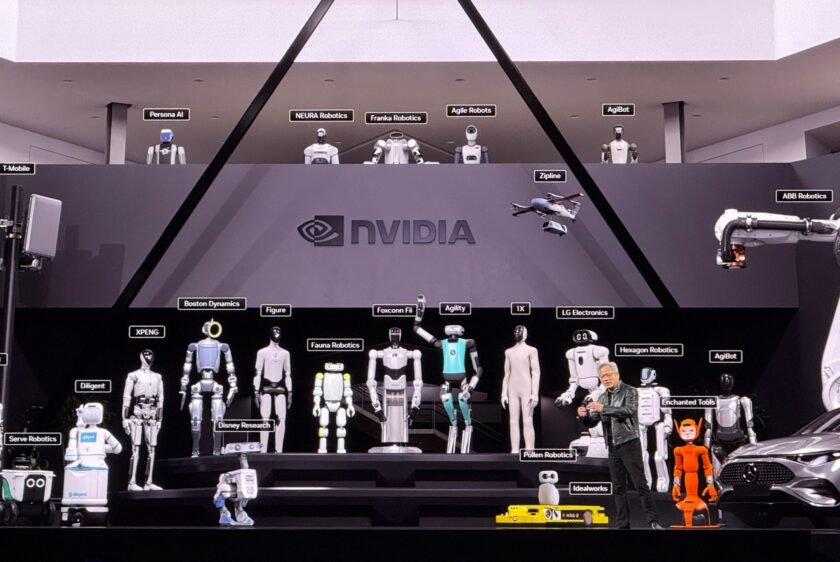
Nvidia CEO Jensen Huang showing off some of the many physical AI agents, aka robots, including autonomous cars.
Drive is Nvidia’s platform for building the latter, and includes the computers, software, and AI tools that help vehicles perceive the world around them, understand what is happening and make driving decisions. Several automakers including Mercedes-Benz, Toyota, Jaguar Land Rover, BYD, and Geely have signed on to use these tools to create advanced driver-assistance and autonomous systems.
So what is Hyperion? Essentially the blueprint for how to build an autonomous driving system using Drive. In industry speak, it’s called the reference design or architecture, and it shows automakers how to combine the Drive computing platform with cameras, radar, lidar, and other hardware in a working vehicle setup. This helps companies develop autonomous cars faster because they don’t have to design the whole system from scratch. The idea is to give manufacturers a standardized starting point, reducing development time and helping companies spread autonomous systems across multiple vehicles and markets.
The big news from GTC 2026 San Jose is that Hyundai, Nissan, BYD, and Geely are developing next-generation autonomous vehicles using the platform’s compute and sensor architecture, while Isuzu is working with Japanese autonomous technology company TIER IV on a Level 4 autonomous bus project powered by Nvidia’s Drive AGX Thor system-on-a-chip.


 English