

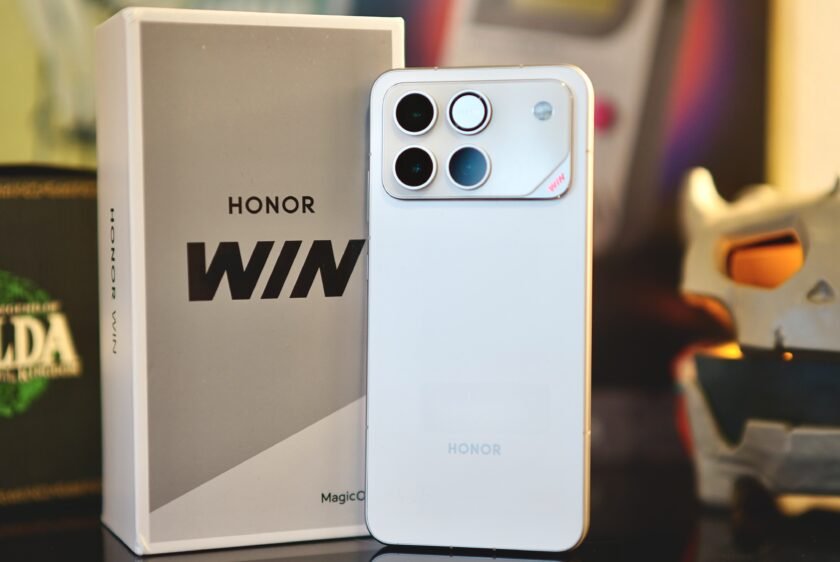
The small fan, elegantly concealed within the camera module, effectively extends the sustained performance of the Snapdragon 8 Elite Gen 5 in the Honor Win and limits throttling. However, the clearly audible fan must be tolerated, although it can be completely disabled if required.
Otherwise, the Honor Win offers all the features expected from a true premium-class phone: a very bright display, a good camera system, and a large 10,000 mAh battery that enables long runtimes and also recharges relatively quickly.
The phone is currently only available as an import from China. European languages are included in the software, but there is no Widevine certification, meaning some streaming content can only be viewed in low resolution. eSIM support is also absent, and there is no periscope zoom camera.
Nevertheless, the Honor Win is an interesting smartphone, especially for gamers who are not bothered by the fan noise during gaming.
Pros
+ effective active cooling
+ very long runtime
+ relatively fast charging
+ bright OLED display
+ sturdy metal casing
+ fast and stable WiFi
+ plenty of memory and RAM on request
+ accurate fingerprint sensor
+ physical camera button
+ good 50 MP main camera
+ many Bluetooth audio codecs
+ hardly any software restrictions despite import
Cons
– Fan clearly audible
– no Widevine L1
– no eSIM support
– no periscope zoom
– only available as a China import
– PWM flickering
– no sustainability information

The Honor Win is currently only available in Europe as a direct import.
Our loaner unit was provided by TradingShenzhen, which charges €737 (approx. $875), including shipping from its EU warehouse.
Translator’s note: Honor smartphones are generally not officially sold in North America (U.S. and Canada).
Display
6.83 inch 13:9, 2800 x 1272 pixel 450 PPI, capacitive touchscreen, OLED, glossy: yes, HDR, 185 Hz
Storage
512 GB UFS 4.1 Flash, 512 GB
, 487 GB free
Connections
1 USB 3.0 / 3.1 Gen1, USB-C Power Delivery (PD), Audio Connections: audio via USB-C, 1 Fingerprint Reader, NFC, Brightness Sensor, Sensors: compass, hall, acceleration, proximity
Networking
802.11 a/b/g/n/ac/ax/be (a/b/g/n = Wi-Fi 4/ac = Wi-Fi 5/ax = Wi-Fi 6/ Wi-Fi 6E 6 GHz be = Wi-Fi 7), Bluetooth 6.0, 5G: n1 / n2 / n3 / n5 / n7 / n8 / n12 / n13 / n18 / n20 / n25 / n26 / n28 / n38 / n40 / n41 / n48 / n66 / n70 / n77 / n78 / n79 / n80 / n81 / n83 / n84 / n89: 4G:FDD-LTE:B1 / B2 / B3 / B4 / B5 / B7 / B8 / B12 / B13 / B17 / B18 / B19 / B20 / B25 / B26 / B28 / B66; TDD-LTE:B34 / B38 / B39 / B40 / B41 / B42 / B48; 3G:B1 / B2 / B4 / B5 / B6 / B8 / B19; 2G:B2 / B3 / B5 / B8, Dual SIM, LTE, 5G, GPS
Size
height x width x depth (in mm): 8.3 x 163.1 x 76.6 ( = 0.33 x 6.42 x 3.02 in)
Battery
10000 mAh Lithium-Ion, 100 Watt wired charging, 80 Watt wireless charging, 27 Watt wired reverse charging
Charging
wireless charging, fast charging / Quickcharge
Operating System
Android 16
Camera
Primary Camera: 50 MPix f/1.95, OIS (camera 1), 50 MP, f/2.4, tele, OIS, 3x zoom (camera 2), 12 MP, f/2.2, ultrawide (camera 3)
Secondary Camera: 50 MPix f/2.0
Additional features
Speakers: stereo speakers with AI subwoofer, charger, USB cable, SIM tool, silicone bumper, 12 Months Warranty, IP68/IP69/IP69K certified; , waterproof
Weight
229 g ( = 8.08 oz / 0.5 pounds) ( = 0 oz / 0 pounds)
Note: The manufacturer may use components from different suppliers including display panels, drives or memory sticks with similar specifications.
The gaming phone’s design is understated: a white matte glass back and a large camera module spanning the entire width, reminiscent of the iPhone 17 Pro.
The metal frame makes the chassis feel very rigid and it could not be twisted in our test. IP68/69K protection even allows submersion in water.
A physical camera button is located on the right side of the chassis.
The USB port supports fast data transfer and also provides DisplayPort output. The phone includes 16 GB of RAM and 512 GB of internal storage; microSD expansion is not supported. A configuration with 12 GB of RAM and 256 GB of storage is also available.
{element.classList.add(‘hideEl’)});document.getElementById(‘showDeviceSizelabel_358486’).checked = false;document.querySelectorAll(‘#showDeviceSize_359179’).forEach(element => {element.classList.add(‘hideEl’)});document.getElementById(‘showDeviceSizelabel_359179’).checked = false;document.querySelectorAll(‘#showDeviceSize_351346’).forEach(element => {element.classList.add(‘hideEl’)});document.getElementById(‘showDeviceSizelabel_351346’).checked = false;document.querySelectorAll(‘#showDeviceSize_353476’).forEach(element => {element.classList.add(‘hideEl’)});document.getElementById(‘showDeviceSizelabel_353476’).checked = false;document.querySelectorAll(‘#showDeviceSize_a6’).forEach(element => {element.classList.add(‘hideEl’)});document.getElementById(‘showDeviceSizelabel_a6’).checked = false;return false;” title=”hide all”>❌
Wi-Fi 7 is supported as the fastest wireless standard, but we were only able to test Wi-Fi 6E using our reference router, the Asus ROG Rapture AXE11000. In this setup, the phone achieves very stable and fast transfer rates of up to 1,756 Mbit/s.
All major 4G and 5G frequency bands are supported, allowing the phone to be used worldwide.
The fingerprint reader is integrated beneath the display panel, works very reliably, and unlocks the phone instantly once a fingerprint is recognized. Facial recognition is also available, but it relies only on the front camera in 2D and is therefore somewhat less secure.
| Networking | |
| Honor Win 802.11 a/b/g/n/ac/ax/be |
|
| iperf3 transmit AXE11000 6GHz |
|
| iperf3 receive AXE11000 6GHz |
|
| Vivo iQOO 15 802.11 a/b/g/n/ac/ax/be |
|
| iperf3 transmit AXE11000 6GHz |
|
| iperf3 receive AXE11000 6GHz |
|
| Honor Magic8 Pro 802.11 a/b/g/n/ac/ax/be |
|
| iperf3 transmit AXE11000 |
|
| iperf3 receive AXE11000 |
|
| iperf3 transmit AXE11000 6GHz |
|
| iperf3 receive AXE11000 6GHz |
|
| Xiaomi 17 Ultra Wi-Fi 7 |
|
| iperf3 transmit AXE11000 |
|
| iperf3 receive AXE11000 |
|
| iperf3 transmit AXE11000 6GHz |
|
| iperf3 receive AXE11000 6GHz |
|
| Average 802.11 a/b/g/n/ac/ax/be |
|
| iperf3 transmit AXE11000 |
|
| iperf3 receive AXE11000 |
|
| iperf3 transmit AXE11000 6GHz |
|
| iperf3 receive AXE11000 6GHz |
|
| Average of class Smartphone |
|
| iperf3 transmit AXE11000 |
|
| iperf3 receive AXE11000 |
|
| iperf3 transmit AXE11000 6GHz |
|
| iperf3 receive AXE11000 6GHz |
|
Honor Win; iperf3 transmit AXE11000 6GHz: Ø945 (713-1091)
Honor Win; iperf3 receive AXE11000 6GHz: Ø1756 (1647-1812)
The Chinese version of MagicOS 10 is preinstalled on our smartphone. The main difference compared to the international version is that Google apps must first be installed manually if needed.
Otherwise, most European languages are available without issues, and even Android Auto and Google Pay work. However, there is no Widevine L1 certification, meaning streaming content from many providers is limited to a maximum of 480p.
Honor provides no information regarding sustainability, although plastic film is used in the packaging. The update policy is expected to include four major software updates.

The 50-megapixel main camera is located on the rear and is supported by a telephoto camera that enables 3× hybrid zoom using different focal lengths. However, there is no optical periscope zoom.
Photos from the main camera show vivid colors and appear sharp, though sometimes over-sharpened. Images remain sharp in low light, but dynamic range in darker areas could be stronger.
The 12-megapixel ultra-wide camera takes acceptable panoramic photos, but fine details are barely recognizable when enlarged.

7.1 ∆E
9 ∆E
9.6 ∆E
6.3 ∆E
7.9 ∆E
7 ∆E
7.1 ∆E
5.5 ∆E
9.8 ∆E
4.9 ∆E
8.3 ∆E
6.4 ∆E
4 ∆E
6.1 ∆E
11.1 ∆E
3.1 ∆E
8.4 ∆E
8.5 ∆E
8.6 ∆E
8.6 ∆E
8.2 ∆E
5.1 ∆E
4.7 ∆E
5.1 ∆E

15.6 ∆E
11.6 ∆E
19.2 ∆E
15.8 ∆E
20.3 ∆E
14.9 ∆E
11.2 ∆E
19.4 ∆E
14 ∆E
17.3 ∆E
5.1 ∆E
8.5 ∆E
17.1 ∆E
15.8 ∆E
10.2 ∆E
5.3 ∆E
15.3 ∆E
20.8 ∆E
19.7 ∆E
17.2 ∆E
16.4 ∆E
19.9 ∆E
18.2 ∆E
12.3 ∆E
The 6.8-inch screen has a resolution of 2,800 × 1,272 pixels. The OLED panel therefore achieves a good pixel density, although other phones such as the Vivo iQOO 15 offer slightly higher resolution. The screen is not quite as bright as the competition in HDR mode or in small bright areas, but it remains easily usable outdoors and also provides very accurate color reproduction.
We detected PWM flickering at 120 Hz, and the manufacturer also states that the frequency can be increased to over 5,000 Hz. Nevertheless, sensitive users should test the display before purchasing.
| 1132 cd/m² |
1145 cd/m² |
1150 cd/m² |
||
| 1166 cd/m² |
1175 cd/m² |
1142 cd/m² |
||
| 1155 cd/m² |
1160 cd/m² |
1129 cd/m² |
||
Distribution of brightness
tested with X-Rite i1Pro 3
Maximum: 1175 cd/m² (Nits) Average: 1150.4 cd/m² Minimum: 1.1 cd/m²
Brightness Distribution: 96 %
Center on Battery: 1175 cd/m²
Contrast: ∞:1 (Black: 0 cd/m²)
ΔE ColorChecker Calman: 1 | ∀{0.5-29.43 Ø4.76}
ΔE Greyscale Calman: 2.1 | ∀{0.09-98 Ø5}
100% sRGB (Calman 2D)
Gamma: 2.253
CCT: 6649 K
| Honor Win OLED, 2800×1272, 6.8″ |
Vivo iQOO 15 AMOLED, 3168×1440, 6.9″ |
Honor Magic8 Pro OLED, 2808×1256, 6.7″ |
Xiaomi 17 Ultra AMOLED, 2608×1200, 6.9″ |
|
|---|---|---|---|---|
| Screen |
-14% |
16% |
8% |
|
| Brightness middle (cd/m²) |
1175 |
1137 -3% |
1809 54% |
1303 11% |
| Brightness (cd/m²) |
1150 |
1113 -3% |
1821 58% |
1300 13% |
| Brightness Distribution (%) |
96 |
96 0% |
95 -1% |
98 2% |
| Black Level * (cd/m²) | ||||
| Colorchecker dE 2000 * |
1 |
1.52 -52% |
1.2 -20% |
1.12 -12% |
| Colorchecker dE 2000 max. * |
2.7 |
3.05 -13% |
2.9 -7% |
2.25 17% |
| Greyscale dE 2000 * |
2.1 |
2.3 -10% |
1.8 14% |
1.7 19% |
| Gamma |
2.253 98% |
2.265 97% |
2.22 99% |
2.242 98% |
| CCT |
6649 98% |
6560 99% |
6446 101% |
6404 101% |
* … smaller is better
| Display / APL18 Peak Brightness | |
| Xiaomi 17 Ultra Adreno 840, SD 8 Elite Gen 5, 512 GB UFS 4.1 Flash |
|
| Honor Magic8 Pro Adreno 840, SD 8 Elite Gen 5, 512 GB UFS 4.1 Flash |
|
| Vivo iQOO 15 Adreno 840, SD 8 Elite Gen 5, 512 GB UFS 4.1 Flash |
|
| Honor Win Adreno 840, SD 8 Elite Gen 5, 512 GB UFS 4.1 Flash |
|
| Display / HDR Peak Brightness | |
| Honor Magic8 Pro Adreno 840, SD 8 Elite Gen 5, 512 GB UFS 4.1 Flash |
|
| Xiaomi 17 Ultra Adreno 840, SD 8 Elite Gen 5, 512 GB UFS 4.1 Flash |
|
| Honor Win Adreno 840, SD 8 Elite Gen 5, 512 GB UFS 4.1 Flash |
|
Screen Flickering / PWM (Pulse-Width Modulation)
ℹ
To dim the screen, some notebooks will simply cycle the backlight on and off in rapid succession – a method called Pulse Width Modulation (PWM) . This cycling frequency should ideally be undetectable to the human eye. If said frequency is too low, users with sensitive eyes may experience strain or headaches or even notice the flickering altogether.
| Screen flickering / PWM detected | 120 Hz Amplitude: 18 % |
 |
|
|
The display backlight flickers at 120 Hz (worst case, e.g., utilizing PWM) . The frequency of 120 Hz is very low, so the flickering may cause eyestrain and headaches after extended use. In comparison: 53 % of all tested devices do not use PWM to dim the display. If PWM was detected, an average of 8016 (minimum: 5 – maximum: 343500) Hz was measured. |
|||
Measurement series with fixed zoom level and different brightness settings (The amplitude curve at minimum brightness looks flat, but this is due to the scaling. The info box shows the enlarged version of the amplitude at minimum brightness)
Display Response Times
ℹ
Display response times show how fast the screen is able to change from one color to the next. Slow response times can lead to afterimages and can cause moving objects to appear blurry (ghosting). Gamers of fast-paced 3D titles should pay special attention to fast response times.
| ↔ Response Time Black to White | ||
|---|---|---|
| 0.8 ms … rise ↗ and fall ↘ combined | ↗ 0.4 ms rise |
 |
| ↘ 0.4 ms fall | ||
| The screen shows very fast response rates in our tests and should be very well suited for fast-paced gaming. In comparison, all tested devices range from 0.1 (minimum) to 240 (maximum) ms. » 2 % of all devices are better. This means that the measured response time is better than the average of all tested devices (20.1 ms). |
||
| ↔ Response Time 50% Grey to 80% Grey | ||
| 1 ms … rise ↗ and fall ↘ combined | ↗ 0.5 ms rise |
 |
| ↘ 0.5 ms fall | ||
| The screen shows very fast response rates in our tests and should be very well suited for fast-paced gaming. In comparison, all tested devices range from 0.165 (minimum) to 636 (maximum) ms. » 3 % of all devices are better. This means that the measured response time is better than the average of all tested devices (31.4 ms). |
||
The Snapdragon 8 Elite Gen 5 is currently one of the most powerful smartphone SoCs, and the Honor Win correspondingly ranks near the top in benchmarks. To maintain performance for longer, Honor installs a small fan that activates when needed but can also be enabled manually. It does not increase peak performance, but keeps performance stable for longer.
In gaming, frame rates of up to 120 fps are possible on low settings, although we could not reach the display’s maximum 185 Hz because hardly any games support it. Frame rates remain very stable, and we observed no stuttering even at high settings.
The fan can automatically switch off when the speakers are in use and is not particularly loud overall, reaching a maximum of about 40 dB(A) at a distance of 15 cm. The speakers can become quite loud, but at maximum volume they sound somewhat treble-heavy. Many Bluetooth audio codecs are supported.
The Honor Win features a very large 10,000 mAh battery: the phone lasted 32:36 hours in our Wi-Fi test, making three days of use without charging realistic. If recharging is required, wired charging supports up to 100 W and takes just over two hours. Wireless charging of up to 80 W is also supported.
| Geekbench 6.5 | |
| Single-Core | |
| Xiaomi 17 Ultra Qualcomm Snapdragon 8 Elite Gen 5, Adreno 840, 16384 |
|
| Honor Magic8 Pro Qualcomm Snapdragon 8 Elite Gen 5, Adreno 840, 12288 |
|
| Honor Win Qualcomm Snapdragon 8 Elite Gen 5, Adreno 840, 16384 |
|
| Average Qualcomm Snapdragon 8 Elite Gen 5 (3498 – 3831, n=11) |
|
| Vivo iQOO 15 Qualcomm Snapdragon 8 Elite Gen 5, Adreno 840, 12288 |
|
| Average of class Smartphone (196 – 3883, n=208, last 2 years) |
|
| Multi-Core | |
| Xiaomi 17 Ultra Qualcomm Snapdragon 8 Elite Gen 5, Adreno 840, 16384 |
|
| Honor Magic8 Pro Qualcomm Snapdragon 8 Elite Gen 5, Adreno 840, 12288 |
|
| Vivo iQOO 15 Qualcomm Snapdragon 8 Elite Gen 5, Adreno 840, 12288 |
|
| Average Qualcomm Snapdragon 8 Elite Gen 5 (10620 – 12383, n=11) |
|
| Honor Win Qualcomm Snapdragon 8 Elite Gen 5, Adreno 840, 16384 |
|
| Average of class Smartphone (830 – 11634, n=208, last 2 years) |
|
| 3DMark | |
| Wild Life Unlimited Score | |
| Xiaomi 17 Ultra Qualcomm Snapdragon 8 Elite Gen 5, Adreno 840, 16384 |
|
| Honor Magic8 Pro Qualcomm Snapdragon 8 Elite Gen 5, Adreno 840, 12288 |
|
| Honor Win Qualcomm Snapdragon 8 Elite Gen 5, Adreno 840, 16384 |
|
| Vivo iQOO 15 Qualcomm Snapdragon 8 Elite Gen 5, Adreno 840, 12288 |
|
| Average Qualcomm Snapdragon 8 Elite Gen 5 (23088 – 30621, n=10) |
|
| Average of class Smartphone (271 – 30621, n=190, last 2 years) |
|
| Wild Life Extreme | |
| Honor Magic8 Pro Qualcomm Snapdragon 8 Elite Gen 5, Adreno 840, 12288 |
|
| Honor Win Qualcomm Snapdragon 8 Elite Gen 5, Adreno 840, 16384 |
|
| Average Qualcomm Snapdragon 8 Elite Gen 5 (6289 – 8329, n=11) |
|
| Vivo iQOO 15 Qualcomm Snapdragon 8 Elite Gen 5, Adreno 840, 12288 |
|
| Xiaomi 17 Ultra Qualcomm Snapdragon 8 Elite Gen 5, Adreno 840, 16384 |
|
| Average of class Smartphone (61 – 8140, n=192, last 2 years) |
|
| Wild Life Extreme Unlimited | |
| Honor Magic8 Pro Qualcomm Snapdragon 8 Elite Gen 5, Adreno 840, 12288 |
|
| Honor Win Qualcomm Snapdragon 8 Elite Gen 5, Adreno 840, 16384 |
|
| Vivo iQOO 15 Qualcomm Snapdragon 8 Elite Gen 5, Adreno 840, 12288 |
|
| Average Qualcomm Snapdragon 8 Elite Gen 5 (6168 – 8102, n=10) |
|
| Xiaomi 17 Ultra Qualcomm Snapdragon 8 Elite Gen 5, Adreno 840, 16384 |
|
| Average of class Smartphone (62 – 8102, n=191, last 2 years) |
|
| GFXBench | |
| on screen Aztec Ruins Normal Tier Onscreen | |
| Xiaomi 17 Ultra Qualcomm Snapdragon 8 Elite Gen 5, Adreno 840, 16384 |
|
| Honor Magic8 Pro Qualcomm Snapdragon 8 Elite Gen 5, Adreno 840, 12288 |
|
| Vivo iQOO 15 Qualcomm Snapdragon 8 Elite Gen 5, Adreno 840, 12288 |
|
| Honor Win Qualcomm Snapdragon 8 Elite Gen 5, Adreno 840, 16384 |
|
| Average Qualcomm Snapdragon 8 Elite Gen 5 (60 – 120, n=10) |
|
| Average of class Smartphone (6.2 – 166, n=205, last 2 years) |
|
| 1920×1080 Aztec Ruins Normal Tier Offscreen | |
| Honor Magic8 Pro Qualcomm Snapdragon 8 Elite Gen 5, Adreno 840, 12288 |
|
| Vivo iQOO 15 Qualcomm Snapdragon 8 Elite Gen 5, Adreno 840, 12288 |
|
| Xiaomi 17 Ultra Qualcomm Snapdragon 8 Elite Gen 5, Adreno 840, 16384 |
|
| Honor Win Qualcomm Snapdragon 8 Elite Gen 5, Adreno 840, 16384 |
|
| Average Qualcomm Snapdragon 8 Elite Gen 5 (203 – 361, n=11) |
|
| Average of class Smartphone (3.4 – 367, n=205, last 2 years) |
|
| on screen Aztec Ruins High Tier Onscreen | |
| Xiaomi 17 Ultra Qualcomm Snapdragon 8 Elite Gen 5, Adreno 840, 16384 |
|
| Honor Magic8 Pro Qualcomm Snapdragon 8 Elite Gen 5, Adreno 840, 12288 |
|
| Honor Win Qualcomm Snapdragon 8 Elite Gen 5, Adreno 840, 16384 |
|
| Vivo iQOO 15 Qualcomm Snapdragon 8 Elite Gen 5, Adreno 840, 12288 |
|
| Average Qualcomm Snapdragon 8 Elite Gen 5 (60 – 120, n=10) |
|
| Average of class Smartphone (0.85 – 144, n=206, last 2 years) |
|
| 2560×1440 Aztec Ruins High Tier Offscreen | |
| Vivo iQOO 15 Qualcomm Snapdragon 8 Elite Gen 5, Adreno 840, 12288 |
|
| Honor Magic8 Pro Qualcomm Snapdragon 8 Elite Gen 5, Adreno 840, 12288 |
|
| Honor Win Qualcomm Snapdragon 8 Elite Gen 5, Adreno 840, 16384 |
|
| Xiaomi 17 Ultra Qualcomm Snapdragon 8 Elite Gen 5, Adreno 840, 16384 |
|
| Average Qualcomm Snapdragon 8 Elite Gen 5 (65 – 145, n=11) |
|
| Average of class Smartphone (1.2 – 146, n=205, last 2 years) |
|
| 3840×2160 4K Aztec Ruins High Tier Offscreen | |
| Honor Magic8 Pro Qualcomm Snapdragon 8 Elite Gen 5, Adreno 840, 12288 |
|
| Vivo iQOO 15 Qualcomm Snapdragon 8 Elite Gen 5, Adreno 840, 12288 |
|
| Honor Win Qualcomm Snapdragon 8 Elite Gen 5, Adreno 840, 16384 |
|
| Xiaomi 17 Ultra Qualcomm Snapdragon 8 Elite Gen 5, Adreno 840, 16384 |
|
| Average Qualcomm Snapdragon 8 Elite Gen 5 (35 – 58, n=10) |
|
| Average of class Smartphone (0.54 – 62, n=206, last 2 years) |
|
| Geekbench AI | |
| Single Precision NPU 1.5 | |
| Honor Magic8 Pro Qualcomm Snapdragon 8 Elite Gen 5, Adreno 840, 12288 |
|
| Honor Win Qualcomm Snapdragon 8 Elite Gen 5, Adreno 840, 16384 |
|
| Xiaomi 17 Ultra Qualcomm Snapdragon 8 Elite Gen 5, Adreno 840, 16384 |
|
| Average of class Smartphone (80 – 5210, n=76, last 2 years) |
|
| Average Qualcomm Snapdragon 8 Elite Gen 5 (511 – 843, n=10) |
|
| Vivo iQOO 15 Qualcomm Snapdragon 8 Elite Gen 5, Adreno 840, 12288 |
|
| Half Precision NPU 1.5 | |
| Average of class Smartphone (80 – 36297, n=76, last 2 years) |
|
| Honor Magic8 Pro Qualcomm Snapdragon 8 Elite Gen 5, Adreno 840, 12288 |
|
| Xiaomi 17 Ultra Qualcomm Snapdragon 8 Elite Gen 5, Adreno 840, 16384 |
|
| Honor Win Qualcomm Snapdragon 8 Elite Gen 5, Adreno 840, 16384 |
|
| Average Qualcomm Snapdragon 8 Elite Gen 5 (486 – 843, n=10) |
|
| Vivo iQOO 15 Qualcomm Snapdragon 8 Elite Gen 5, Adreno 840, 12288 |
|
| Quantized NPU 1.5 | |
| Average of class Smartphone (133 – 49889, n=76, last 2 years) |
|
| Honor Magic8 Pro Qualcomm Snapdragon 8 Elite Gen 5, Adreno 840, 12288 |
|
| Honor Win Qualcomm Snapdragon 8 Elite Gen 5, Adreno 840, 16384 |
|
| Xiaomi 17 Ultra Qualcomm Snapdragon 8 Elite Gen 5, Adreno 840, 16384 |
|
| Average Qualcomm Snapdragon 8 Elite Gen 5 (974 – 1986, n=10) |
|
| Vivo iQOO 15 Qualcomm Snapdragon 8 Elite Gen 5, Adreno 840, 12288 |
|
| CrossMark | |
| Overall | |
| Honor Win Qualcomm Snapdragon 8 Elite Gen 5, Adreno 840, 16384 |
|
| Honor Magic8 Pro Qualcomm Snapdragon 8 Elite Gen 5, Adreno 840, 12288 |
|
| Average Qualcomm Snapdragon 8 Elite Gen 5 (1698 – 2856, n=8) |
|
| Average of class Smartphone (187 – 2856, n=115, last 2 years) |
|
| Productivity | |
| Honor Win Qualcomm Snapdragon 8 Elite Gen 5, Adreno 840, 16384 |
|
| Honor Magic8 Pro Qualcomm Snapdragon 8 Elite Gen 5, Adreno 840, 12288 |
|
| Average Qualcomm Snapdragon 8 Elite Gen 5 (1380 – 2366, n=8) |
|
| Average of class Smartphone (198 – 2366, n=115, last 2 years) |
|
| Creativity | |
| Honor Win Qualcomm Snapdragon 8 Elite Gen 5, Adreno 840, 16384 |
|
| Honor Magic8 Pro Qualcomm Snapdragon 8 Elite Gen 5, Adreno 840, 12288 |
|
| Average Qualcomm Snapdragon 8 Elite Gen 5 (1357 – 2123, n=8) |
|
| Average of class Smartphone (163 – 2123, n=115, last 2 years) |
|
| Responsiveness | |
| Honor Win Qualcomm Snapdragon 8 Elite Gen 5, Adreno 840, 16384 |
|
| Honor Magic8 Pro Qualcomm Snapdragon 8 Elite Gen 5, Adreno 840, 12288 |
|
| Average Qualcomm Snapdragon 8 Elite Gen 5 (6210 – 12907, n=8) |
|
| Average of class Smartphone (239 – 13042, n=115, last 2 years) |
|
| Honor Win | Vivo iQOO 15 | Honor Magic8 Pro | Xiaomi 17 Ultra | Average 512 GB UFS 4.1 Flash | Average of class Smartphone | |
|---|---|---|---|---|---|---|
| AndroBench 3-5 |
-1% |
19% |
22% |
2% |
-34% |
|
| Sequential Read 256KB (MB/s) |
2856.3 |
2556.87 -10% |
3942.69 38% |
3987.92 40% |
3677 {el.classList.toggle(‘hideEl’);});return false;”>?(1954 – 4110, n=28) 29% |
2165 {el.classList.toggle(‘hideEl’);});return false;”>?(270 – 4370, n=195, last 2 years) -24% |
| Sequential Write 256KB (MB/s) |
2745.2 |
2589.26 -6% |
3732.81 36% |
3974.23 45% |
3216 {el.classList.toggle(‘hideEl’);});return false;”>?(1240 – 4035, n=28) 17% |
1852 {el.classList.toggle(‘hideEl’);});return false;”>?(103.2 – 4051, n=195, last 2 years) -33% |
| Random Read 4KB (MB/s) |
471.2 |
453.54 -4% |
488.67 4% |
547.56 16% |
396 {el.classList.toggle(‘hideEl’);});return false;”>?(279 – 576, n=28) -16% |
294 {el.classList.toggle(‘hideEl’);});return false;”>?(47.6 – 576, n=195, last 2 years) -38% |
| Random Write 4KB (MB/s) |
594.7 |
689.01 16% |
587.11 -1% |
524.05 -12% |
461 {el.classList.toggle(‘hideEl’);});return false;”>?(48.2 – 689, n=28) -22% |
343 {el.classList.toggle(‘hideEl’);});return false;”>?(9.4 – 987, n=195, last 2 years) -42% |
|
|||||||||||||||||||||||||
| Maximum: 49.5 °C = 121 F Average: 47.7 °C = 118 F |
|||||||||||||||||||||||||
|
|||||||||||||||||||||||||
| Maximum: 47.8 °C = 118 F Average: 45.5 °C = 114 F |
|||||||||||||||||||||||||
Power Supply (max.) 41.9 °C = 107 F | Room Temperature 21 °C = 70 F | Fluke t3000FC (calibrated), Voltcraft IR-260
(-) The average temperature for the upper side under maximal load is 47.7 °C / 118 F, compared to the average of 32.9 °C / 91 F for the devices in the class Smartphone.
(-) The maximum temperature on the upper side is 49.5 °C / 121 F, compared to the average of 35.2 °C / 95 F, ranging from 21.9 to 247 °C for the class Smartphone.
(-) The bottom heats up to a maximum of 47.8 °C / 118 F, compared to the average of 34 °C / 93 F
(+) In idle usage, the average temperature for the upper side is 24.3 °C / 76 F, compared to the device average of 32.9 °C / 91 F.
| 3DMark | |
| Wild Life Stress Test Stability | |
| Honor Win Adreno 840, SD 8 Elite Gen 5, 512 GB UFS 4.1 Flash |
|
| Honor Win Adreno 840, SD 8 Elite Gen 5, 512 GB UFS 4.1 Flash |
|
| Xiaomi 17 Ultra Adreno 840, SD 8 Elite Gen 5, 512 GB UFS 4.1 Flash |
|
| Vivo iQOO 15 Adreno 840, SD 8 Elite Gen 5, 512 GB UFS 4.1 Flash |
|
| Honor Magic8 Pro Adreno 840, SD 8 Elite Gen 5, 512 GB UFS 4.1 Flash |
|
| Wild Life Extreme Stress Test | |
| Honor Win Adreno 840, SD 8 Elite Gen 5, 512 GB UFS 4.1 Flash |
|
| Xiaomi 17 Ultra Adreno 840, SD 8 Elite Gen 5, 512 GB UFS 4.1 Flash |
|
| Vivo iQOO 15 Adreno 840, SD 8 Elite Gen 5, 512 GB UFS 4.1 Flash |
|
| Honor Magic8 Pro Adreno 840, SD 8 Elite Gen 5, 512 GB UFS 4.1 Flash |
|
| Solar Bay Stress Test Stability | |
| Xiaomi 17 Ultra Adreno 840, SD 8 Elite Gen 5, 512 GB UFS 4.1 Flash |
|
| Honor Magic8 Pro Adreno 840, SD 8 Elite Gen 5, 512 GB UFS 4.1 Flash |
|
| Steel Nomad Light Stress Test Stability | |
| Honor Win Adreno 840, SD 8 Elite Gen 5, 512 GB UFS 4.1 Flash |
|
| Xiaomi 17 Ultra Adreno 840, SD 8 Elite Gen 5, 512 GB UFS 4.1 Flash |
|
| Honor Magic8 Pro Adreno 840, SD 8 Elite Gen 5, 512 GB UFS 4.1 Flash |
|
Honor Win; Wild Life Extreme Stress Test; 1.1.14.3: Ø25.9 (22-28.3)
Honor Win; Wild Life Stress Test Stability; with activated fan: Ø104.8 (100-137.8)
Honor Win; Wild Life Stress Test Stability; 0.0.0.0: Ø98.5 (77.8-142.4)
Honor Win; Steel Nomad Light Stress Test Stability; 1.0.6.2: Ø13.2 (11.9-13.3)
The Honor Win is an extremely fast gaming phone with active cooling and a very large battery.
Even as an import, it has only a few usage limitations.

Honor Win
– 02/13/2026 v8
Florian Schmitt
Connectivity
60 / 69 → 87%
Games Performance
42 / 55 → 77%
Application Performance
96 / 85 → 100%
Smartphone – Weighted Average
CO2 Emissions
No Data
Materials
5%
Packaging
10%
Power Use
50%
Repairability
6%
Software Updates
50%
 Total Sustainability Score: 20.2%
|
Image |
Model / Review |
Price |
Weight |
Drive |
Display |
|---|---|---|---|---|---|
|
1. 87.6%
|
Honor Win Qualcomm Snapdragon 8 Elite Gen 5 ⎘ Qualcomm Adreno 840 ⎘ 16 GB Memory, 512 GB |
Amazon: 1. Charlotte’s Web 2. Screen Protector for Honor W… 3. Shantime [2 Pack Tempered Gl… List Price: 737€ |
229 g | 512 GB UFS 4.1 Flash | 6.83″ 2800×1272 450 PPI OLED |
|
2. 88.6%
|
Vivo iQOO 15 Qualcomm Snapdragon 8 Elite Gen 5 ⎘ Qualcomm Adreno 840 ⎘ 12 GB Memory, 512 GB |
Amazon: 1. NEOYUKL Privacy Screen Prote… 2. for Vivo iQOO 15 Ultra (6.85… 3. Ibywind for vivo iQOO 15 5G … List Price: 580€ |
215 g | 512 GB UFS 4.1 Flash | 6.85″ 3168×1440 508 PPI AMOLED |
|
3. 89.3%
|
Honor Magic8 Pro Qualcomm Snapdragon 8 Elite Gen 5 ⎘ Qualcomm Adreno 840 ⎘ 12 GB Memory, 512 GB |
Amazon: 1. Ibywind for Honor Magic8 Pro… 2. UOGNADGD 6-Pack Tempered Gla… 3. [5 Pack] Screen Protector fo… List Price: 1300€ |
219 g | 512 GB UFS 4.1 Flash | 6.71″ 2808×1256 458 PPI OLED |
|
4. 90.4%
|
Xiaomi 17 Ultra Qualcomm Snapdragon 8 Elite Gen 5 ⎘ Qualcomm Adreno 840 ⎘ 16 GB Memory, 512 GB |
Amazon: 1. Fhyeugfy for Xiaomi 17 Ultra… 2. Luchantle 2 Pack Camera Lens… 3. Anbzsign 2+2 Pack for Xiaomi… List Price: 950€ |
224 g | 512 GB UFS 4.1 Flash | 6.90″ 2608×1200 416 PPI AMOLED |




Transparency
The selection of devices to be reviewed is made by our editorial team. The test sample was provided to the author as a loan by the manufacturer or retailer for the purpose of this review. The lender had no influence on this review, nor did the manufacturer receive a copy of this review before publication. There was no obligation to publish this review. As an independent media company, Notebookcheck is not subjected to the authority of manufacturers, retailers or publishers.
This is how Notebookcheck is testing
Every year, Notebookcheck independently reviews hundreds of laptops and smartphones using standardized procedures to ensure that all results are comparable. We have continuously developed our test methods for around 20 years and set industry standards in the process. In our test labs, high-quality measuring equipment is utilized by experienced technicians and editors. These tests involve a multi-stage validation process. Our complex rating system is based on hundreds of well-founded measurements and benchmarks, which maintains objectivity. Further information on our test methods can be found here.
Related Articles

Editor of the original article: Florian Schmitt – Managing Editor Mobile – 1406 articles published on Notebookcheck since 2009
I initially wrote about gaming laptops when I joined Notebookcheck in 2009. I was then involved with the setup of the comparison portal Notebookinfo and worked with social media concepts for large companies like BMW and Adidas, while also returning to work for Notebookcheck in 2012. Nowadays, I focus on smartphones, tablets, and future technologies. Since 2018 I have been Managing Editor for mobile device reviews, working alongside my colleague Daniel Schmidt.

Translator: Ninh Ngoc Duy – Editorial Assistant – 711034 articles published on Notebookcheck since 2008
My main responsibility as an editorial assistant is maintaining the Library section, which aggregates reviews from other publications and channels. In addition, my daily breakfast is Notebookcheck’s long list of new content, which I comb through to select the most interesting topics for translation from English to French, Italian, Spanish, Portuguese, and Dutch.”
Florian Schmitt, 2026-02-18 (Update: 2026-02-18)


 English