

BMX SolidSafe Air
ZDNET’s key takeaways
- The BMX SolidSafe Air is available now for $60.
- It’s the thinnest Qi2 power bank I’ve tested, with a semi-solid-state battery that’s safer and less flammable than regular lithium-ion batteries.
- It’s rather expensive for a power bank.
View now at Heybmx
Follow ZDNET: Add us as a preferred source on Google.
The problem with MagSafe power banks is that there are very few that don’t make my iPhone 17 Pro Max too big to hold. Even the smaller ones aren’t comfortable. This partly due to my genetics (yes, I have small fingers), and partly due to the fact that putting this oversized smartphone into a chunky case makes it even more unwieldy.
Also: The thinnest MagSafe charger I’ve tested adds almost no weight to my iPhone
Add to that my predisposition for larger power banks, and the problem is exacerbated. This is why, over the past couple of years, my preference for wireless power banks has shifted from the larger 10,000 mAh and 20,000 mAh packs to the more compact 5,000 mAh ones.
They’re smaller, lighter, and ultimately more convenient, and as such less likely to be left at home. So, when I was offered the chance to review the new BMX SolidSafe Air, marketed as the world’s thinnest 5,000 mAh Qi2 power bank (and one that won several awards at CES 2026) I jumped at the opportunity.
Let’s start with how thin the SolidSafe Air is. It’s only 0.27 inches (6.8 mm) or, for a fun comparison, about four nickels or seven credit cards stacked together. And in case Warren Buffett is reading this, that’s roughly a stack of sixty $100 bills.
Now, if you bought this power bank you might notice that the packaging claims the SolidSafe Air is “just 3 credit cards thin,” but I’ve said it’s seven. What gives? A standard, ISO/IEC 7810-compliant credit card measures exactly 3.375 × 2.125 × 0.03 inches.
Cards must be this thickness to work with payment machines and ATMs. Cards with embossed numbers can appear thicker due to the raised letters and numbers, and if you stack multiple embossed cards, the thickness might seem closer to three or four cards.
This is one of the thinnest power banks I’ve tested.
Adrian Kingsley-Hughes/ZDNET
However, I’ve gone by the ISO standard measurement, especially since many modern cards now have printed details rather than embossed ones.
Also: I thought this 245W charging station was excessive, but it’s an office essential for me now
No matter how you measure it, this power bank is thin. While I haven’t handled and tested every power bank out there, I’ve tested units from pretty much all the big names, from Anker, Baseus, and Cuktech, to Rolling Square, Ugreen, and Zendure, and this is the thinnest one I’ve seen with similar specs.
The rest of its dimensions — 4.1 × 2.8 inches and weighing 4.1 oz — are in the right ballpark for this type of power bank. If you wanted a lighter power bank, the Baseus Picogo Magsafe AM41 is a bit lighter at 3.8 oz, but it’s only Qi-compatible.
BMX have really given the titanium on this power bank an excellent finish.
Adrian Kingsley-Hughes/ZDNET
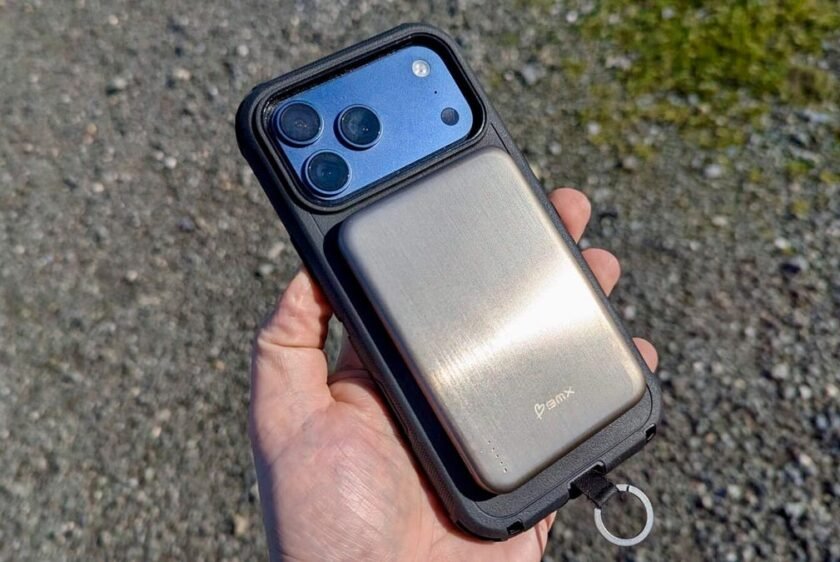
The front of the unit, where the Qi2 charging pad is housed, is made of a tough polymer, while the back features a brushed titanium shell. The titanium is lightweight yet durable, and the brushed finish helps hide scratches and abrasions. On the back, you’ll also find tiny holes that show the LEDs of the battery level indicator. It’s small and discreet, yet it does the job.
Also: I bought this bizarre wireless charger for my Apple Watch, and it’s already saved me multiple times
The Qi2 wireless charging pad delivers up to 15W of power and is backward-compatible with older Qi devices. This will work with a range of devices, from the Apple iPhone to Samsung Galaxy and Google Pixel devices.
I estimate the magnetic clamping force to be around the 11N standard, which is strong enough to hold it in place even when the phone is in a thick case, such as the Otterbox Defender that my iPhone lives in.
This power bank isn’t going anywhere!
Adrian Kingsley-Hughes/ZDNET
On the bottom of the pack is a single USB-C port that supports 15W input and output. Since the SolidSafe Air supports pass-through charging, you can wirelessly charge your phone while the power bank itself is charging via cable. And yes, there’s a basic cable included with the power bank, but it’s not the type that attaches and doubles as a lanyard.
Inside the polymer and titanium shell is a 5,000 mAh/19.25 Wh semi-solid-state battery, which is not only safer but also much more fire-resistant than a regular lithium-ion battery. Not to mention that it’s good for 1,000 recharge cycles. This is thanks to the flammable liquid electrolyte being replaced by a slurry or gel, which is less flammable and reduces the risk of leakage.
Also: 10 useful cables and connectors I use everyday (and they’re affordably priced)
Just keep in mind that 5,000 mAh is not a lot of power — about enough to recharge an iPhone once — and it loses efficiency when charging wirelessly (for Qi2, the typical efficiency is in the region of 65 to 70%, which is much more efficient than earlier Qi units).
Attached to a smartphone, however, the SolidSafe Air disappears, barely adding any bulk or weight to the device. I find my iPhone to still be very usable, both single-handed and dual-handed, when the SolidSafe Air is attached, with the titanium back of the unit being very grippy. It’s a good choice of material for the back of the unit.
It adds very little weight or bulk to a smartphone.
Adrian Kingsley-Hughes/ZDNET
Last time I decided to put a spike through a solid-state battery for science, I had feedback off a few people saying that I shouldn’t have removed the battery or I should have pierced it through the metal as well to give it the best chance of going bad. So I fully charged the power bank, donned my safety specs, and got to work.
DON’T TRY THIS AT HOME!
All I managed was to get the tiniest glowing ember and a bit of smoke.
After all that, it was a bit warm, but nothing spectacular.
Yes, this is a very safe power bank.
ZDNET’s buying advice
Overall, the BMX SolidSafe Air is a great power bank that ticks a lot of boxes. It’s a small, relatively lightweight, energy-dense package that can deliver a lot of power to a smartphone quickly and relatively efficiently. It also looks good and is built to last, and I can see how it did so well at CES this year.
It’s also pricey. At $60 each, you could buy two Baseus PicoGo power banks and still have change for a Big Mac meal. However, you don’t get the Qi2 charging, having to make do with Qi, so there are more efficiency losses, and you don’t get the safety associated with a semi-solid-state battery. So, for me, in situations where the power bank could be damaged, and that damage could cause injury or further damage, the SolidSafe Air is a good choice.


 English