

When we consider buying a new car, most people focus on the sticker price. The problem is, that’s just part of the story. Your decision about which vehicle to purchase should consider all aspects of vehicle ownership, also known as the total cost of ownership, over the life of the vehicle.
Until now, it was difficult to identify and compare the many attributes required to make this calcualtion across multiple vehicles on your short list.
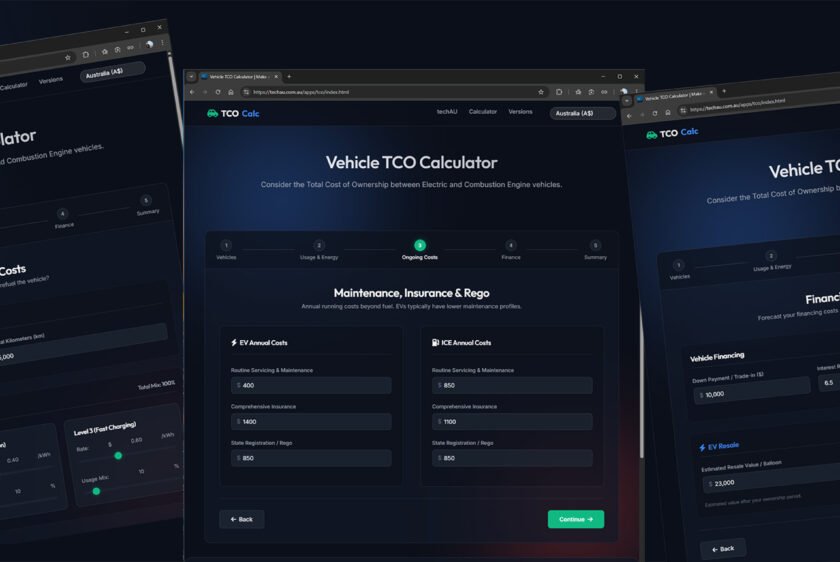
The new TCO Calculator uses a 5-step process to capture the inputs (defaults help speed up the process), and compare 2 vehicles, showing the different between EV and ICE vehicles. Note: Hybrids are found under the vehicle selection for ICE.
Electric Vehicles now account for close to 14% of new vehicle sales in Australia and those owners recognise significantly lower ongoing costs than those who buy ICE vehicles, which is often a net positive over a fixed period (i.e. 3-5 years) for a similar car.
At the end of the 5-steps, you’ll receive a summary and breakdown of which vehicle has a lower TCO, to help inform your next buying decision. From there you can revision the inputs and adjust things like your expected timeframe for ownership, charging vs petrol costs etc.
Why total cost of ownership matters
The Total Cost of Ownership, or TCO, is a financial estimate intended to help buyers determine the direct and indirect costs of a product. In the automotive world, this includes everything from the purchase price to fuel, maintenance, and insurance.
While an EV might cost more upfront, the running costs are significantly lower. Electricity is cheaper than petrol, and because there are fewer moving parts, servicing is generally more affordable and less frequent.
By looking only at the purchase price, many Australians are missing out on the potential to save thousands of dollars over the life of their vehicle. Our new tool aims to put those savings front and centre so you can compare vehicles fairly.

How the TCO website works
The website has been built from the ground up to be simple, fast, and highly customisable. We know that every driver has different habits, and a one-size-fits-all approach simply doesn’t work when it comes to financial planning.
Users can input specific details about the vehicles they are considering, including the purchase price and expected ownership period. You can also adjust variables like annual kilometres driven and the efficiency of the vehicle.
The calculator then processes these numbers to show you a side-by-side comparison. It reveals the cost per year, the cost per month, and even the cost per kilometre, which is a great way to understand your daily commute.
Comparing internal combustion to electric
The real power of the TCO calculator is comparing a traditional Internal Combustion Engine vehicle against a modern Battery Electric Vehicle. This is where the “EV tax” at the dealership often disappears when you look at the monthly budget.
For example, if you drive 15,000 kilometres a year, the fuel savings alone can be substantial. When you add in the reduced maintenance costs and the lack of oil changes, the gap closes remarkably quickly.
In many cases, an EV that costs A$10,000 more upfront can actually be cheaper to own over a five-year period. This web app makes that data visible and easy to share with family members or business partners.
Customising for Australian conditions
We have tailored this tool specifically for the Australian market. This includes things like local energy prices and the specific incentives that might be available in different states and territories.
Pricing for electricity can vary wildly depending on whether you have solar panels at home or if you rely on public charging networks. The site allows you to tweak these figures to match your specific living situation.
We also use A$ currency formatting throughout to ensure the data is easy to read and relevant to our local audience. There is no need to do mental math conversions from US Dollars or other regions.
In recent version updates, US pricing has also been added with a country selector availlable in the top-right. Over time, I expect to add support for more locations, please request these in the comments.
Features
Simple and easy to use, 5-step process. When I started building this I wanted this to be informative, but also had to be fun to use. That meant spending time on the design to be far more than a spreadsheet.
For those who want to get deep into the weeds, the calculator supports advanced inputs. You can factor in things like registration costs, insurance premiums, and the estimated resale value of the car. Resale value, or depreciation, is often the largest cost of owning any new vehicle. By including this in the calculation, you get a much more honest view of what that new car smell is actually costing you over time.
Vehicle images also help to keep the experience visual, and these are generated thanks to Google’s Gemini NanoBana Pro.
Model selection allows you to pick different trim levels which have different prices attached, different range (in the case of EVs), making the calaculations more accurate. If you still don’t arrive at a price tag similar to your shortlisted vehicle, you can manually adjust the defaults are really just the starting point.
A word on the data
Data is only as good as the inputs provided, so we encourage users to look up their specific insurance quotes and electricity rates. However, even with conservative estimates, the results are often eye-opening.
You may be surprised to find that a premium EV can have a lower TCO than a mid-range petrol SUV, particularly if you plan on keeping the vehicle over the longer term. This shift in perspective is exactly why I decided to build and host this tool on techAU.
“My goal with the TCO calculator is to remove the guesswork around all vehicle costs. To allow buyers to undertand the sticker price is just one data point, but there are many other factors that should be considered. Making that quick and easy to understand is key to them making the right long-term decision and if that results in more EVs on the road, that’s a good thing.
Jason Cartwright, Founder, techAU.
What is next for the TCO Calculator ?
This is just the first public release of the tool, and we have plenty of updates planned for the future. We are looking at expanding the vehicle selection, the ability to compare 2 EVs and the ability to export the summary report.
Most all I want to hear from the community about what features you would like to see. Your feedback helps make the tool more useful to more people and particularly can help those looking to make the switch to electric.
This project has been in development for more than a year and has now reached a maturity that I’m happy to share with the world.
I hope you enjoy using it, please share it with friends and family.
🚀 LAUNCH: Ever wondered what your car actually costs you? Not just the sticker price, but the long-term reality?
Our new Vehicle TCO (Total Cost of Ownership) Calculator is now LIVE! 🚗
Factor in depreciation, fuel/charging, insurance, and more to see the real numbers.
Watch… pic.twitter.com/XqCXJnXKy5
— techAU (@techAU) February 21, 2026
For more information, head to https://techau.com.au/apps/tco/


 English