
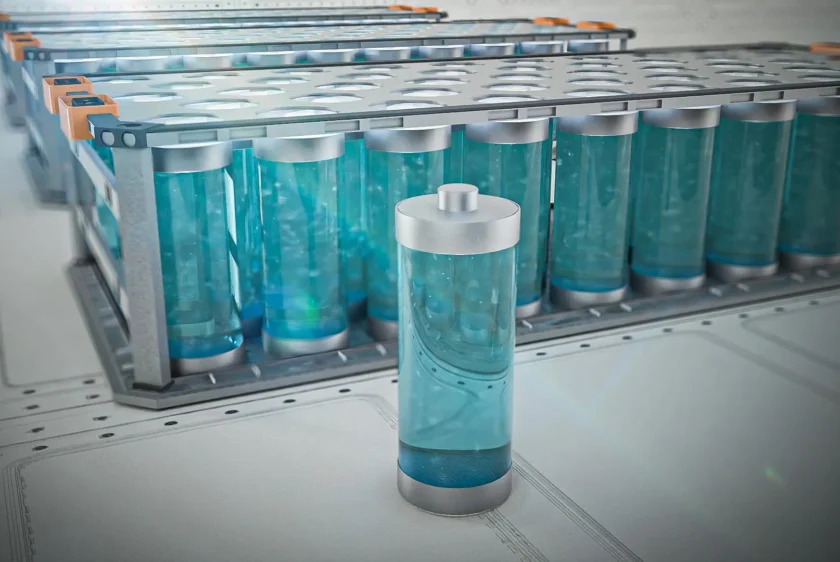
Sodium-ion batteries are emerging as a promising option for cleaner, more sustainable energy storage. Researchers at the University of Surrey have identified a surprisingly simple way to improve their performance by keeping water inside a critical battery material instead of removing it.
Lithium-ion batteries currently dominate the market, but they depend on costly materials that can harm the environment. Sodium, by contrast, is abundant and widely accessible. Even so, matching the performance of lithium-ion technology has been a major hurdle for sodium-ion systems.
Water Boosts Sodium Vanadium Oxide Performance
In research published in the Journal of Materials Chemistry A, scientists examined sodium vanadium oxide, a well-known sodium-based compound. They discovered that allowing the material to retain its natural water content significantly enhances how it functions inside a battery.
The compound, called nanostructured sodium vanadate hydrate (NVOH), delivered far stronger results when used in its hydrated form. It stored substantially more energy, charged at a faster rate, and maintained stability for more than 400 charge cycles.
During testing, the hydrated version held nearly twice as much charge as standard sodium-ion cathode materials. This performance places it among the top cathodes reported so far for sodium-ion batteries.
Dr. Daniel Commandeur, Research Fellow at the University of Surrey School of Chemistry and Chemical Engineering, and lead author of the paper, said:
“Our results were completely unexpected. Sodium vanadium oxide has been around for years, and people usually heat-treat it to remove the water because it’s thought to cause problems. We decided to challenge that assumption, and the outcome was far better than we anticipated. The material showed much stronger performance and stability than expected and could even create exciting new possibilities for how these batteries are used in the future.”
Seawater Operation and Electrochemical Desalination
The team also explored how the material performed in salt water, an especially demanding environment for battery systems. Not only did it continue operating effectively, it also removed sodium ions from the saltwater solution. At the same time, a graphite electrode extracted chloride ions in a process known as electrochemical desalination.
Dr. Commandeur added:
“Being able to use sodium vanadate hydrate in salt water is a really exciting discovery, as it shows sodium-ion batteries could do more than just store energy — they could also help remove salt from water. In the long term, that means we might be able to design systems that use seawater as a completely safe, free and abundant electrolyte, while also producing fresh water as part of the process.”
Toward Safer, Low Cost Alternatives to Lithium
This advance could speed up the adoption of sodium-ion batteries as a practical alternative to lithium-based technology. Because sodium is inexpensive and plentiful, these batteries have the potential to be safer, more affordable, and more environmentally friendly.
Possible uses include large-scale renewable energy storage for power grids as well as applications in electric vehicles. By simplifying the production of high-performance sodium-ion batteries, the Surrey team’s findings move commercially viable, sustainable energy storage one step closer to reality.


 English