

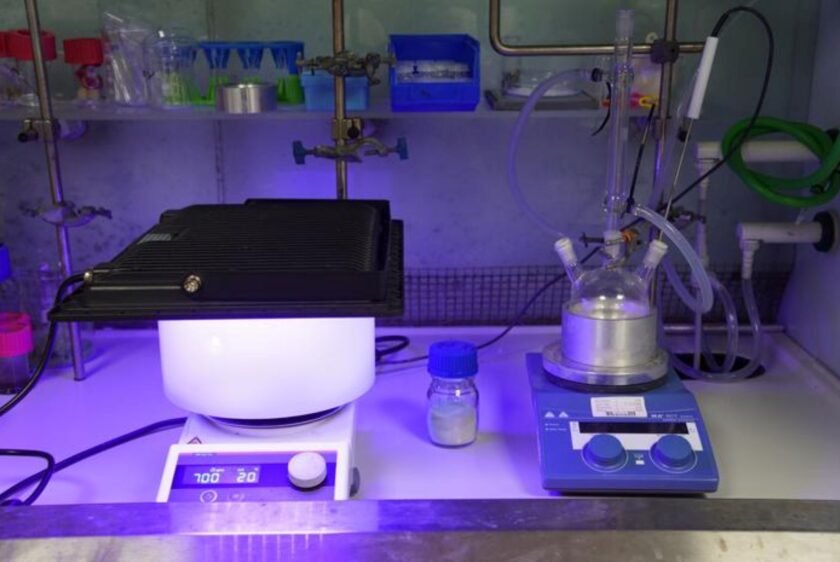
Mountains of plastic waste: PET bottles, nylon fibers and polyurethane foam, typify our throwaway culture. They choke rivers, smother oceans and do not decompose. But what if these plastics could be converted, not as pollutants, but into clean energy and high-value chemicals?
A team of researchers has revealed a new frontier, which does exactly that. They have created a solar-powered reactor that can decompose durable plastic waste. Using a process called photoreforming (PR), the system, powered using recycled acid from old car batteries, transforms these plastics into clean hydrogen fuel and industrially useful chemicals.
Powered by sunlight, the reactor demonstrates a more environmentally friendly and economical approach than conventional chemical processes for recycling. In lab tests, the reactor reliably cranked out large amounts of hydrogen gas and also bedded acetic acid down to an exact degree. Ominously, it ran for over 260 hours in a lossless condition.
Central to this innovation is a new type of acid-stable photocatalyst: cyanamide-functionalized carbon nitride supported with cobalt-promoted molybdenum disulfide, CoMoS₂-CNx. When evaluated under AM 1.5G simulated sunlight conditions, the catalyst provided a product of PET-derived hydrogen at a rate of 0.35 g. Under 405 nm LED irradiation, this yield increased to as much as 1.9 mmol/g; for nylon 66 and polyurethane, the performance was even better (producing respectively up to 1.0 and 4.2 mmol H2/g material within just 24 h).
A solar-powered system turns plastic and greenhouse gases into a sustainable energy
The catalyst showed stable performance, maintaining activity over 11 days in which ethylene glycol up to 40 % was converted (89% selectivity toward acetic acid; 9% quantum yield) Essentially, it’s not just powerful but also durable.
Lead author Kay Kwarteng, a PhD candidate in Reisner’s research group, who developed the photocatalyst, said, “The discovery was almost accidental. We used to think acid was completely off-limits in these solar-powered systems because it would simply dissolve everything. But our catalyst developed didn’t, and suddenly a whole new world of reactions opened up.”
The team’s approach uses acid from used car batteries to break down plastic waste into smaller chemical components, like ethylene glycol. Then, with the help of a sunlight-powered catalyst these elements are converted into hydrogen fuel and acetic acid, one of vinegar’s main ingredients.
This method is particularly interesting because it uses acid that has been recycled from old car batteries to dissolve plastics, making something useful out of a waste material. Not only could their method make recycling large volumes of plastic materials economically feasible, but it also could provide new opportunities for how we deal with the 30 million tons of it’s and junk each year.
Annually, billions of old batteries are disposed of around the world, each containing between 20 to 40% acid by volume. The lead is usually recycled and sold, but the residual acid is often treated with base to neutralize it, as there’s little demand for that. This new method gives that waste a second life.
Lead author Kay Kwarteng, a PhD candidate in Reisner’s research group, who developed the photocatalyst, said, “Acids have long been used to break plastics apart, but we never had a cheap and scalable photocatalyst that could withstand them. Once we solved that problem, the advantages of this type of system became obvious.”
“If we can collect the acid before it’s neutralized, we can use it again and again to break down plastics: it’s a real win-win, avoiding the environmental cost of neutralizing the acid, while putting it to work generating clean hydrogen.”
Instead, far from marking the end of the line for plastics, this research treats them as a gateway to one new: factories powered by sunlight where yesterday’s bottles and foams become tomorrow’s fuels and chemicals.
The researchers claim that their method could cut costs, compared with other plastic-to-fuel processes, by about a factor of ten. This is due to the acid’s ability to boost hydrogen production that can be repurposed instead of wasted.
This approach is not intended to supersede regular recycling. Instead, it assists in processing dirty or mixed plastics that are difficult to recycle with traditional methods.
“We’re not promising to solve the global plastics problem,” said Reisner. “But this shows how waste can become a resource. Using sunlight and discarded battery acid to turn plastic waste into something valuable makes this approach very promising.”
Journal Reference:
- Papa K. Kwarteng, Yongpeng Liu, Chen Han et al. Solar reforming of plastics using acid-catalyzed depolymerization. Joule. DOI: 10.1016/j.joule.2026.102347


 English