
Oleh Trytiachenko/Getty Images
The world of power is changing quite a bit right now, with big tech companies going in hard on nuclear energy and even looking for other ways to power the data centers that they are building. Earlier this year, Google announced it had some massive plans to build a new data center in Minnesota. While Google is one of many investing heavily in nuclear energy right now, the company has also invested in other power-related projects, like a new type of battery system that uses an unlikely component to generate power: rust.
The new battery is from a company called Form Energy, and it will provide Google with a new type of battery that uses a specially designed system to deliver 300 megawatts of electricity and up to 100 hours of operational run time. The battery in question will use what the company refers to as an iron-air battery, which essentially uses oxygen to “breathe” as it produces electricity. On top of being a particularly interesting battery design, the company also claims that the new battery is the “largest battery project by gigawatt-hour energy capacity announced to date in the world.”
As if that wasn’t impressive enough, the battery will also work alongside Google and Xcel Energy’s plans to bring 1,900 megawatts of clean energy to the Minnesota grid, using wind, solar, and long-duration energy storage to do so.
A battery unlike any other
Mike Mareen/Shutterstock
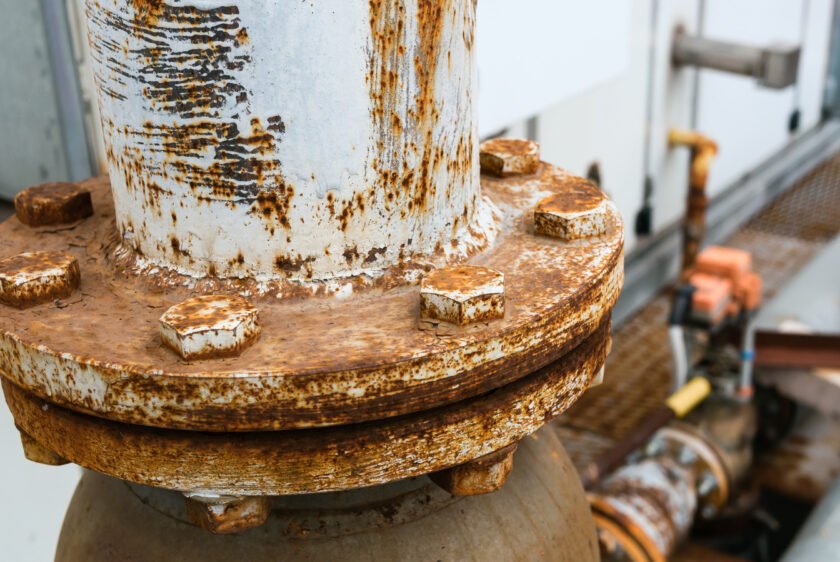
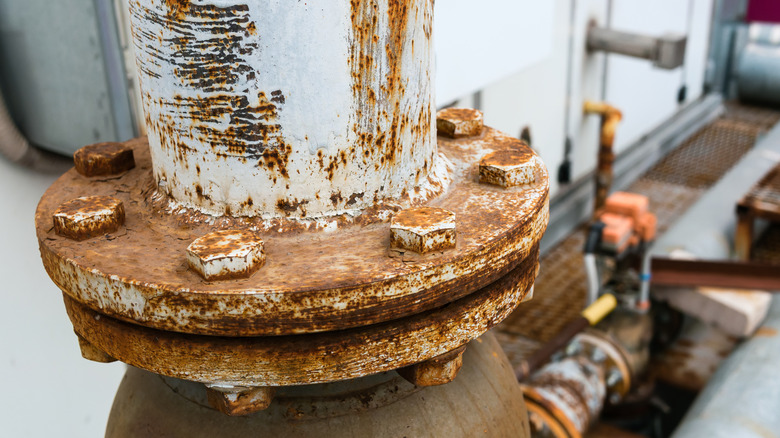
What is especially exciting about this new battery design from Form Energy is the fact that it doesn’t use lithium or any other rare materials to power the energy storage. Instead, it uses iron, air, and water, which combine together to create an abundance of rust. The principle here appears to be using rusting that is reversible. Form Energy’s battery takes the natural process of rusting and instead of simply scraping it off, the battery goes through a process of rusting and de-rusting. To do this, the battery is designed to pull in air while it is discharging electrical energy. This leads to oxidation and turns the iron into rust.
Then, when the battery becomes depleted, and needs to be recharged, the electrical current helps to turn the rust back into useable iron, thus releasing the oxygen back into the air. This allows the process to utilize the same material over and over again, without requiring the use of rare materials such as lithium — or even sodium, which has become a popular lithium alternative in recent years.
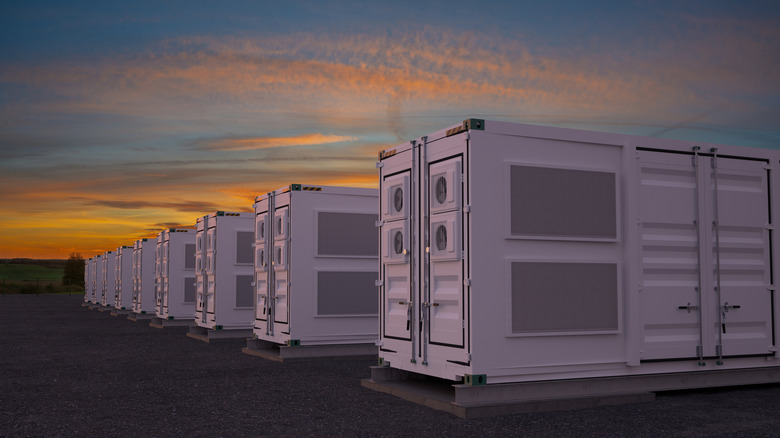
The idea is to provide clean energy that uses natural processes and helps provide a safer way of storing energy, since Form Energy’s battery doesn’t use any flammable materials to store its energy. The batteries, however, are massive, with the cells reportedly being stored in enormous enclosures that can be as large as a shipping container. That size is obviously not ideal, but for big data centers, it should work out fine. This is also an interesting move, as more and more companies are working to bring next-gen nuclear factories to the U.S. However, systems like Form Energy’s provide a cleaner route to more energy.


 English