

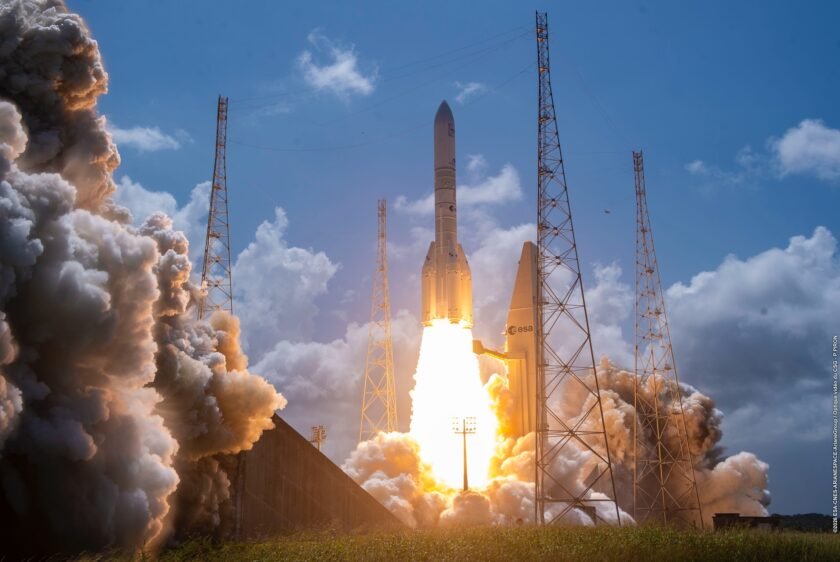

MOUNTAIN VIEW, Calif. — The more powerful version of Europe’s Ariane 6 rocket successfully placed a group of Amazon Leo broadband satellites into orbit on the vehicle’s inaugural launch Feb. 12.
The Ariane 64 lifted off from Kourou, French Guiana at 11:45 a.m. Eastern on Arianespace’s VA267 mission. The vehicle’s upper stage completed its deployment of 32 Amazon Leo satellites nearly two hours later.
The launch was the first for the Ariane 64, a version of the Ariane 6 with four solid-fuel strap-on boosters. The five previous flights of the Ariane 6 were of the Ariane 62 variant, with two strap-on boosters. The Ariane 64 can place about 20 tons into low Earth orbit, twice the performance of the Ariane 62.
The launch was the first of 18 missions by Arianespace for Amazon, its biggest commercial customer. Those missions required the use of the more powerful Ariane 64 as well as a longer payload fairing 20 meters long, also used for the first time on this launch.
“With the first flight of Ariane 64, Europe’s heavy-lift launcher has demonstrated its ability to deliver the most demanding large-scale constellation missions,” David Cavaillolès, chief executive of Arianespace, said in a statement after the launch.
At a Jan. 15 briefing, Cavaillolès said Arianespace expected to perform “several” Amazon Leo launches in 2026, but did not disclose a specific number or range. He said the company projects seven or eight Ariane 6 launches this year, double the four it did in 2025, using a mix of Ariane 62 and Ariane 64 vehicles.
The European Space Agency noted that the launch is part of the agency’s strategy to recover from a “launcher crisis” a few years ago that prevented Europe from launching its own payloads. That was resolved by the introduction of the Ariane 62 in 2024 and the return to flight of the Vega C rocket later that year
“This first flight of Ariane 64 sustains Europe’s autonomous access to space,” said Toni Tolker-Nielsen, ESA’s director of space transportation. “We can transport small to large payloads to close or faraway orbits with ESA’s complete fleet of rockets: Vega C, Ariane 62 and Ariane 64.”
Further upgrades are planned for the Ariane 6, including replacing the P120C solid motors on the strap-on boosters with larger P160C boosters. Cavaillolès said in January that it will increase the vehicle’s performance by 10–15%, but did not state how that would translate into additional Amazon Leo satellites that the rocket could carry.
The launch also sustains Amazon’s deployment of the Amazon Leo, formerly Project Kuiper, constellation. The company has now placed into orbit 212 satellites on this launch and previous flights of the Atlas 5 and Falcon 9.
However, Amazon is far behind the pace needed to meet the deadline in its Federal Communications Commission license to have half of its 3,232 satellites in orbit by late July. Amazon filed a request Jan. 30 to extend that deadline by two years, or waive it entirely, citing launch delays.
Amazon also said it was buying 10 more Falcon 9 launches to accelerate deployment of the constellation and increasing the number of firm orders for Blue Origin New Glenn launches from 12 to 24. The company announced no changes in its contract with Arianespace.

Jeff Foust writes about space policy, commercial space, and related topics for SpaceNews.
He earned a Ph.D. in planetary sciences from the Massachusetts Institute of Technology and a bachelor’s degree with honors in geophysics and planetary science…
More by Jeff Foust


 English