

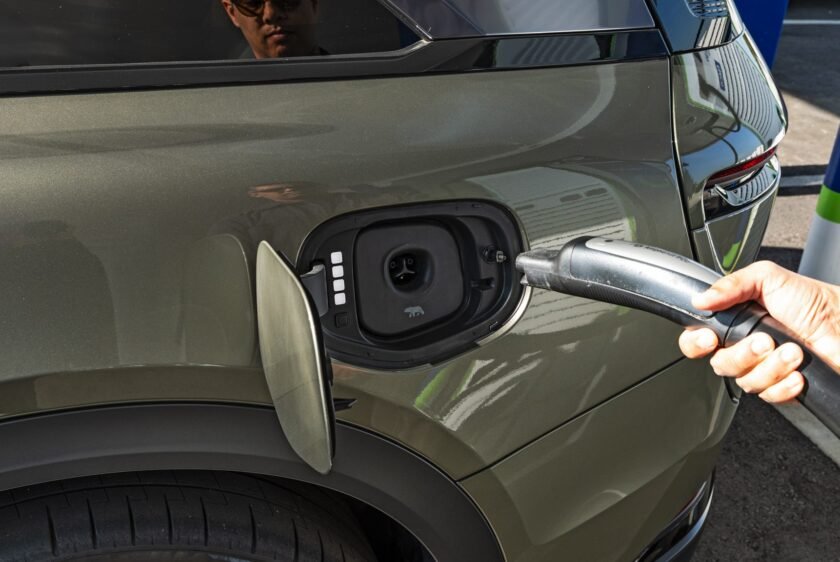
Time comes for us all, and our vehicles are no exception. Rust, electrical problems, engine wear—they’re inevitable with the passage of time. For EVs, the prevailing fear with age is the degradation of their battery packs and a resultant loss of range. But it turns out that may not be the case at all. A new report from Recurrent Auto says a drop in vehicle range takes much longer than we might think. That’s great news for those shopping for a used EV, as is the fact that the march of progress means the used fleet increasingly includes vehicles with more and more range to begin with.
The report was created from data Recurrent gathers on thousands of EV owners in the U.S. It found that the average real-world range of a BEV has now climbed to 325 miles across 2026 model year vehicles, a stark improvement since 2020, where the average expected range was just 261 miles. It’s also up from 293 miles last year. And it’s not just from increased battery capacity, as thermal management and aerodynamic efficiency have improved.
While much of this improved efficiency is countered by the large size of most EVs. the data shows that the most efficient EVs still outperform the average energy use of 37.5 kWh per 100 miles by 40 percent. And with the improvements to charging technology since 2020, the fastest charging EVs can now add up to 100 miles of range in 10 minutes.
And EV drivers are able to exploit their greater range for longer than you might expect. Recurrent found that three-year-old EVs retain 97 percent of their original range on average, and 95 percent range after five years. In fact, some 68 percent of 2023-model-year vehicles actually exceed their original EPA range. Translated to the real world, that means a 2026 model EV with a 300-mile range rating would be able to travel 291 miles in three years and 285 two years after that.
This range retention isn’t due to any new battery chemistries, but instead smarter software. One such advancement is how a battery pack’s capacity is utilized. In virtually every case, as a reserve, an EV does not access 10 percent or so of its overall capacity even when it says it’s fully charged. As a battery cells age and degrade, the battery management system shifts the energy load from the older cells with less capacity to ones with more to retain most of your range. It’s like bringing battery cells off the bench in the third or fourth quarter.
The other strategy is done through vehicle telematics and over-the-air (OTA) updating. EVs are loaded with algorithms that retune the range estimate and energy management based as a vehicle ages and its battery pack loses capacity, helping make the driving experience roughly the same throughout the vehicle’s lifespan. We’re interested to see how much range is retained within the EV fleet after 8 or 10 years, as well, now that there are enough on American roads to produce meaningful data.


 English