

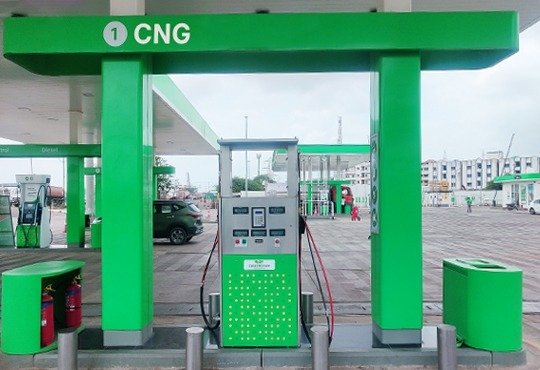
The Manufacturers Association of Nigeria (MAN) has called on the government to accelerate the Presidential Compressed Natural Gas (CNG) Initiative by heavily subsidising the conversion of commercial and industrial transport fleets.
The association said that Logistics accounts for a massive chunk of consumer goods inflation and that shifting from Petrol and Diesel to abundant, locally sourced CNG is the ultimate inflation-buster.
“We should not expand trade deficits through petroleum imports; we should focus on removing supply-side bottlenecks for manufacturers. This includes optimising the National Single Window (NSW) platform; removing the critically burdensome 4 per cent FOB levy and facilitating single-digit credit facilities for manufacturers to scale production and lower unit costs.
“The reliance on liquid fuels for industrial production is a major component of our energy crisis. Fixing the national grid and incentivising captive, off-grid renewable power solutions for industrial clusters will significantly reduce our dependence on costly refined petroleum.” it said.
The director general of the MAN, Segun Ajayi-Kadir, in a brief, titled, “Fuel Importation Prescription As A Recipe For Deindustrialisation And National Economic Retrogression” said that the Association has reviewed the April 2026 Nigeria Development Update (NDU) by the World Bank, alongside its subsequent clarification regarding the downstream petroleum sector, but while welcoming the Bretton Woods institution’s clarification that national energy security is paramount in today’s volatile global climate, Manufacturers reiterate its fundamental objection to the initial premise that reinstating petrol import licenses is a viable, long-term strategy to avert an inflation spike. It is not, and should not be considered as an option.
The Association viewed the suggestions by the World Bank that Nigeria should throw open competition in its downstream oil industry by invoking the policy of petrol importation as improper.
In clear terms, suggesting that Nigeria should open its borders to imported Premium Motor Spirit (PMS) to solve an inflationary crisis is structurally flawed, counterproductive, and highly detrimental to Nigeria’s industrialization agenda. In the long run, it will perpetually constrain Nigeria into the circle of exporting jobs and wealth, and importing poverty, says the Association.
Stating clear the MAN’s position, Ajayi-Kadir, said the “The World Bank’s report posited that the suspension of import licenses stifled competition, allowing domestic ex-depot prices to rise, thereby driving up inflation. This analysis panders to short-term bias and does not take into account the following foundational macroeconomic realities of the Nigerian economy:”
According to him, Nigeria’s inflation is fundamentally cost-push and can be aggressively driven by exchange rate volatility. Therefore, promoting PMS imports means returning to the era of fiercely competing for scarce foreign exchange (FX) to fund foreign refineries. Such depletion of FX depreciates the Naira further. A weakened Naira spikes the cost of importing critical raw materials and machinery for domestic manufacturers, triggering a far bigger wave of inflation across all sectors of the economy than a temporary 12 per cent differential in fuel pump prices.
He noted that for decades, Nigeria exported raw crude only to import refined products; effectively exporting our wealth, jobs, and capital to subsidize the manufacturing sectors of Europe and Asia. Halting import licenses and empowering local refining is the most significant structural victory Nigeria has achieved in its energy sector in fifty years. Therefore, reverting to importation is to succumb to economic sabotage.
Continuing, the DG, said “As the World Bank’s retraction eventually conceded, global energy supply chains are highly vulnerable to rising geopolitical tensions, particularly those in the Middle East. Relying on imported fuel exposes Nigeria to damaging external supply shocks. True and lasting price stability can only be achieved through local production, where internal supply buffers insulate the domestic market from international crude freight premiums and global supply chain disruptions.
He added, “Rather than giving consideration (whether now or in the future) to the short-sighted and destructive route of importing our way out of an inflation crisis, MAN advocates for practical, home-focused, and sustainable measures to mitigate the global energy supply shock and lower consumer prices:
The Association recommended that while the implementation of crude oil sales in Naira to local refineries is a landmark structural victory, its current execution requires unmitigated optimization, the Federal Government should mandate total transparency in the domestic pricing matrix and ensure that local refineries receive their full, unhindered daily crude quotas without bureaucratic bottlenecks. The true macroeconomic benefit of this policy must be allowed to materialize for the end consumer and the productive sector.
Ajayi-Kadir, noted that oil is a critical global resource, and national sufficiency should be the goal of all progressive economies.
“Solving for a competitive retail market for PMS should not approximate to promoting fuel importation. Importation of PMS will undermine domestic refining capacity; contribute to the disruption of the foreign exchange market; disincentivize investment in and expansion of local refining, and truncate the relief that Nigerians have started to enjoy since the advent of Dangote Refinery and other local refineries.
“MAN firmly reiterates its position that, as a country, we must strive to produce what we consume and consume what we produce. It is not in our national interest to perpetuate avoidable dependence on imported fuel, when we are numbered among the leading producers of crude oil and have domestic capacity to meet national demand and even export. No, we shouldn’t!
“We urge the federal government to be wary of neo-liberal prescriptions that could jeopardize or decimate our hard-won domestic manufacturing capabilities. The path to inclusive growth, a strong Naira, more jobs, single-digit inflation, and a prosperous Nigeria is surer when we protect our local industries. We should therefore reject any policy recommendation that would ultimately lead to the exportation of jobs and importation of poverty” he concluded.
We’ve got the edge. Get real-time reports, breaking scoops, and exclusive angles delivered straight to your phone. Don’t settle for stale news. Join LEADERSHIP NEWS on WhatsApp for 24/7 updates →
Join Our WhatsApp Channel


 English